CityVoiceCLE Local updates. Clear action.

Revisiting ARPA: Time is Running Out!

by Tanisha Pruitt Policy Matters Ohio

The pandemic took a toll on Americans from all walks of life, especially school children and educators. Throughout the pandemic, parents, children and teachers navigated school closures, hybrid learning and constantly evolving safety protocols. Coming out of the pandemic, Ohio’s schools are still recovering from  learning loss, struggling to  recruit and retain educators, scrambling to employ the proper number of  qualified support staff  and dealing with issues getting students to and from school due to the lack of buses and a reduction in the number of qualified,  bus drivers well-trained bus drivers to drive them. The good news is that the state still has available federal funds that can help, but only a year left to use the funds wisely so Ohio students and educators can get what they need to thrive in school.

The $1.9 trillion American Rescue Plan (ARP) signed by President Biden in March 2021 dedicated $122 billion to support primary and secondary education, so schools could address learning loss, retool for new safety requirements and improve technology. Starting in 2021, districts across Ohio received disbursements of the state’s $4.4 billion in ARP funds for K-12 schools. The state currently has 8% of these funds remaining, which schools must spend by September 30th, 2024.

 The ARP funds were the third in a series third in a series of federal supports disbursed as Elementary and Secondary School Emergency Relief (ESSER):

ESSER I ($489,205,200): Funded by the Coronavirus Aid, Relief, and Economic Security Act (CARES Act), which was enacted on March 20th, 2020. This funding was available March 13, 2020-September 30, 2022.

ESSER II ($1,991,251,095): Funded by the Coronavirus Response and Relief Supplemental Appropriations Act (CRRSA), which was enacted on December 27, 2020. This funding was available December 27, 2020-September 30, 2023.

ARP ESSER (ESSER III) ($4,475,243,513): Funded by the American Rescue Plan Act (ARPA), which was enacted on March 11, 2021. The funding is available until September 30, 2024.

Most districts have utilized all their ESSER I-II funds:

District Examples:

 Cleveland Heights-University heights school district:

ESSER III (ARP ESSER) Funds Usage CATEGORY TOTAL
Activities to address learning loss, e.g. summer and after school programming $1,437,133.37
Maintain operations and continuity of services $1,260,120.63
Provide mental health services and supports $787,651.21
Purchase educational technology $763,903.78
Implement public health protocols $46,587.42
TOTAL TO DATE (6/17/2022): $4,295,396.41 

 CMSD:  The impact of ESSER funds has greatly impacted the Cleveland Metropolitan School District, according to Chief Executive Officer Eric Gordon, who, along with two colleagues, shared how the district is investing ESSER funds at the district and school level to improve academic achievement.

Gordon said that during the Covid-19 pandemic, district-based and school-based educators made a pact when schools shut down for in-person learning that they were determined not to return to business as usual after the pandemic ended. As a result, they created a plan titled “Our Vision for Learning in a Post-Pandemic World” to help guide the district.

“We made a bet that if we invest in things such as out of school time and summer learning experiences that deepen and broaden the rich learning environment for young people in the context of rigorous academic content,” said Gordon, “we can move achievement, and we can use ESSER dollars to jump start this vision and then build a bridge to sustainability long term,” said Gordon.

Elementary and Secondary School Emergency Relief (ESSER) 507
Provides emergency relief grants to school districts related to the COVID-19 pandemic. Restrictions include, but are not limited to, providing for coordination of preparedness and response efforts, training and professional development of staff, planning and coordination during long-term closure, and purchasing technology for students.

 Read more on Cleveland.com

Cleveland Preparatory Academy:

The Academy will use ARP ESSER funds to implement the following:
1. Universal and correct wearing of masks – as directed by the CDC – all applicable individuals will be provided with the necessary PPE (purchased through ARP ESSER) if they do not have their own.
2. Physical distancing – ARP ESSER funds will be used to maximize all instructional spaces on campus both indoors and outdoors through reasonable construction projects.
3. Handwashing and respiratory etiquette – ARP ESSER funds will be used to update any facilities needed to increase student and staff access to handwashing facilities.
4. Cleaning and maintaining healthy facilities, including improving ventilation – ARP ESSER funds will be used to update and maintain HVAC and ventilation systems to improve air quality and air flow in the school. Funds will also be used for increased cleaning around the school. The facilities will also
be updated with surfaces throughout the building and outside that enable effective cleaning of high touch areas.
2. How the LEA will use the funds it reserves under section 2001(e)(1) of the ARP Act to address the academic impact of lost instructional time through the implementation of evidence-based interventions, such as summer learning or summer enrichment, extended day, comprehensive afterschool programs, or
extended school year.
A portion of the required 20% will be allocated to addressing the academic impact of lost instructional time through summer learning and enrichment as well as comprehensive after school programs that include both tutoring and enrichment. During the course of the school day, students will also receive
small group instruction through a combination of intervention teachers from Title I and ESSER funds.
3. How the LEA will spend its remaining ARP ESSER funds consistent with section 2001(e)(2) of the ARP Act; and The remaining ARP ESSER funds dedicated to academic intervention under the 20% set aside will be focused on intervention materials and staff. The Academy has purchased an online platform that includes iReady (diagnostic and data-driven instruction), Mastery Connect (short cycle assessments) as well as several intervention programs including ILX, BrainPOP, Raz-Kids and supplemental programs like

Here is the ODE Dashboard where Districts can track their ARP ESSER allocations and spending.

Districts now have the remaining ARP ESSER (ESSER III) funds, which were distributed in July of 2021, to use before the deadline. Funding allocations are distributed to districts based on enrollment and number of students in low-income families to ensure that districts with high concentrations of economically disadvantaged students receive the funding that they need and deserve. This will benefit larger urban districts such as Cleveland Metropolitan School District (CMSD), which received $295 million in ARP ESSER funds. CMSD has $77,521,935 remaining funds to spend before the deadline next year.

The United States Department of Education makes clear that schools must use ARP funds to:

  • Open safely and remain open.
  • Dedicate 20% of funds to helping students recover academically and emotionally from losing a year in the classroom.
  • Prevent layoffs and hire any additional personnel to help get students back on track.
  • Provide enrichment learning, summer school and early education programs to maintain equity and aid in instructional loss during the pandemic.
  • Address physical and mental health needs of students.
  • Ensure a safe and healthy school environment, with windows that open and good air circulation, through renovations and improvements to schools’ HVAC systems.

What should districts use the remaining ARP ESSER funds for?

The large influx of federal K-12 aid can help Ohio school districts expand opportunities for all students, no matter where they live or how much money their families have. School districts serving higher percentages of students with low incomes will on average have received higher allocations of the funds. All Ohio school districts have a responsibility to use ARP funds to address the most urgent setbacks during the pandemic and give all students the support they need to flourish.

Districts around the state have already begun making plans for what they intended to use the remaining funds for ahead of the deadline:

Columbus City Schools: Columbus City Schools plans to use $1 million to provide mental health support for students and staff, including hiring more licensed mental health professionals that can address needs in their schools.

Middletown City School District: Middletown City school district plans to use $6 million for continued recovery to mitigate learning loss and provide extended education opportunities, such as hiring counselors and offering after school programs, to improve student academic outcomes.

Akron Public Schools: Akron public city school district plans to use $3 million to hire more educators as an effort to reduce class sizes and an additional $300,000 for substitute teachers to help mitigate teacher shortages in the district.

Additional Uses of ARP ESSER:

In addition to using federal relief aid for learning loss recovery and mental health supports, the Biden administration also plans to set aside $9 billion  in American Rescue Plan funding to address the teacher shortage nationwide. School districts in Ohio can add that funding to the $4.4 billion the state is already receiving in ARP dollars to address the current issues the state is navigating with recruiting and retaining qualified educators and support staff. Additionally, to address some of the transportation issues that districts have been facing in recent years, funds can be used to purchase more buses and hire more transportation staff.

Today, many of the same lawmakers who passed state budgets that erode resources from our public schools are seizing the opportunity to pit parents against teachers and school administrators – aiming to further undercut public education by subsidizing tuition for students to attend private schools. ARP dollars show how public funding can help get kids back on track in the classroom and provide the necessary support and services that they need. We can help keep schools safe and functional by monitoring ARP dollars coming into our districts and by encouraging administrators to use the funds to address staff shortages.

Most school districts post details of their ARP plans on their websites. Click here for highlights from Ohio’s Elementary and Secondary School Emergency Relief ARP Plans. Also, if you would like to track how much your district received in ARP ESSER funding, you can find that here.
What the guilty verdicts in the HB 6 corruption case mean for energy policy and good government in Ohio

Experts see the case against former Ohio House Speaker Larry Householder and lobbyist Matt Borges as a test of limits on dark money in Ohio politics.

By Kathiann M. Kowalski

This article is provided by Eye on Ohio, the nonprofit, nonpartisan Ohio Center for Journalism, in partnership with the nonprofit Energy News Network. Please join the free mailing lists for Eye on Ohio or the Energy News Network, as this helps provide more public service reporting.

Jurors in Ohio’s House Bill 6 criminal corruption case have returned guilty verdicts against both former Ohio House Speaker Larry Householder and lobbyist and former Ohio Republican Party chair Matt Borges.

Beyond the verdicts, experts say the case is notable for what it revealed about the systemic nature of political corruption in Ohio.

“Among the most jarring aspects of this case, besides the sheer scale of dark money funneled to Ohio politicians, was the degree to which corrupt activity was treated by elected officials as the ‘normal way of doing business,’” said Kyle Marcum, policy director for Ohio Citizen Action.

Householder and Borges were charged with violating the federal Racketeer Influenced and Corrupt Organizations Act, or RICO, for actions relating to their roles in a $60 million scheme to pass and protect Ohio’s nuclear and coal bailout law, which also gutted the state’s clean energy standards.

Most of the money came from FirstEnergy and its affiliates. And most of the funds flowed through dark money organizations — groups that did not have to report their donors and can generally avoid campaign finance limits if they don’t coordinate activities with a candidate or campaign.

Money in the HB 6 case was “no mere ordinary satchel of cash politicians whip up,” said David Niven, who teaches about Ohio state politics at the University of Cincinnati. Rather, the government alleged there was a criminal enterprise under a statute generally used to go after organized crime.

And while there was a single count under RICO for each defendant, the government’s allegations amounted to a charge that there was “a concerted effort to pervert, in this case, the laws of Ohio,” Niven said.

“If that was ‘business as usual’ in politics, then the business of politics needs to change,” said Vipal Patel, former acting U.S. Attorney for the Southern District of Ohio, who is now at Squire Patton Boggs law firm.

For Niven, the case is “a pretty dramatic wakeup call that the normal course of business in Ohio has slipped, way, way, way off the rails.”

“We need to rebuild Ohioans’ trust in our state’s leadership, and we need an end to fossil fuel and utility corruption,” said Nolan Rutschilling, managing director of energy policy for the Ohio Environmental Council.

Judge Timothy Black’s jury instructions ran 72 pages long. Jury deliberations lasted less than a day and a half following a full day of closing arguments on Tuesday and rebuttal on Wednesday.

The case is important for Ohio and nationally regardless of how the verdict came out.

“It does show that everybody is accountable for their conduct, and that while money is a part of our political system, there is a line that donors and elected officials cannot cross,” said Michael Benza, who heads the Financial Integrity Institute at Case Western Reserve University School of Law,

“This trial laid bare how Ohio’s energy policy has been influenced by utility interests and how urgently Ohio needs comprehensive climate and energy reform,” said Marcum. “After so many years of energy policy that largely favors utilities and fossil fuels, Ohio needs equitable, forward-looking solutions that will protect our air and water, the health of Ohioans, and provide clean energy jobs to keep Ohio competitive in the 21st-century economy.”

Prosecutors faced a big challenge in presenting their case, largely because dark money groups that don’t have to report their donors have played such a big role in U.S. politics since the Supreme Court’s Citizens United ruling and other cases. Even before that, utilities and fossil fuel interests have long been among big spenders in Ohio politics.

“Money is in fact the currency of politics. Power is the currency of politics,” Benza said. But when money is given with the expectation that someone will use their office to provide a benefit, “that’s when it becomes corruption.”

“There’s a lot of gray area between an outright bribe and campaign contributions meant to elect someone who might be sympathetic to a company and expected to at least listen to the company’s viewpoints on policy issues,” said Ashley Brown, former head of the Harvard Electricity Policy Group.

Evidence in the Householder case supported a finding that there was an explicit quid pro quo, Brown said. FirstEnergy “wanted something very tangible in the form of major legislation.”

As House speaker, Householder made sure that legislation passed. Money from FirstEnergy and its affiliates also funded efforts to prevent voters from getting a chance to repeal HB 6 via a referendum.

“I feel our community owes Assistant United States Attorney and Deputy Criminal Chief Emily Glatfelter and her team of prosecutors and law enforcement agents a debt of gratitude,” Patel said, adding that it’s an understatement to say they went beyond simply “a good day’s work.”

A complex case

The six-week trial, which began Jan. 23, involved thousands of pages of exhibits, along with video, voice recordings and witness testimony.

The government’s case traced the flow of money from FirstEnergy, its subsidiaries and others through dark money groups and into accounts controlled by defendants.

The government also showed how various transfers of money correlated with dates of meetings, texts, or phone calls involving one or more defendants, executives for FirstEnergy or its subsidiaries, lobbyists acting on behalf of the companies, and others.

Additional evidence documented how funds from the unlawful enterprise benefited individual defendants in the case. Householder also increased his power by getting elected speaker, and plans were underway to let him extend that tenure, the government argued.

FBI special agent Blane Wetzel was the government’s star witness. For more than a week, he described documentary evidence and explained recordings of defendants, co-conspirators and others.

Wetzel also recounted meetings with whistleblowers, such as former lawmaker Dave Greenspan and voter referendum worker Tyler Fehrman, at places such as a Bob Evans restaurant and a Graeter’s Ice Cream shop.

In contrast, trial exhibits showed Householder met with FirstEnergy executives at places like pricey steakhouses in Washington, D.C. After Householder later contested those facts, Wetzel described a group photo showing FirstEnergy’s then-vice president Michael Dowling, Householder’s son Luke, and what appeared to be Householder’s knee in pants he’d worn earlier that day. Data showed the photo was taken close to a Charlie Palmer’s Steakhouse in Washington, D.C.

Also taking the stand during the government’s case were co-defendants Juan Cespedes and Jeff Longstreth, who previously pled guilty in the hope of receiving lighter sentences. Cespedes acted as a lobbyist for FirstEnergy Solutions, and Longstreth was president of Generation Now, the central dark money group in the scheme. Neil Clark, another alleged co-conspirator, died in 2021, but his voice was heard in several recordings.

FBI agent Nathan Holbrook testified about his separate investigation of Clark. Several former lawmakers said they felt undue pressure from Householder to support HB 6. Householder fundraiser Anna Lippincott and consultant Megan Fitzmartin also took the stand during the government’s case.

Fehrman was the government’s last witness. He said Borges bribed him during the drive for a ballot referendum on HB 6. Statements made by Borges in recordings made Fehrman feel threatened, he added.

“I’m going to blow your house up,” Borges told Fehrman in one recording, referring to the possibility of a reporter asking about their dealings.

Householder was his own star witness, taking the stand after several other witnesses. He claimed he was not bribed and wanted HB 6 to pass in any case. And he denied having control over Generation Now.

Householder also said money the group used to repay a debt and make repairs at a Florida house he owned was a loan. His lawyer, Steven Bradley, called the $500,000 in personal benefits anothing burgerin his closing argument.

Prosecuting attorney Emily Glatfelter’s cross-examination not only contradicted points from Householder’s testimony, but also reinforced points supporting elements of the government’s case.

In contrast to claims that no one was threatened if they didn’t support HB 6, for example, the government played a recording of Householder telling Clark, “Just say if you’re going to f— with me, I’m going to f— with your kids.” One of the underlying offenses alleged in the indictment was interference with interstate commerce by threats or violence.

Glatfelter similarly challenged Householder’s claim that he didn’t have any control over Generation Now, even though he raised money for it, by presenting him with evidence where Householder reviewed the organization’s ads and asked for changes.

What’s next?

“Through its verdict today, the jury reaffirmed that the illegal acts committed by both men will not be tolerated and that they should be held accountable,” said Kenneth Parker, U.S. Attorney for the Southern District of Ohio.

The defendants could face up to 20 years in prison. Any post-trial motions, including ones that might ask for a new trial, must be filed within 14 days of the verdict, unless Judge Black extends the time.

Sentencing would take place after the resolution of those motions. “Defendants would then have 14 days after entry of judgment to appeal to the United States Court of Appeals for the Sixth Circuit,” said court spokesperson Jennifer Thornton.

The government may still file criminal charges against additional defendants. Parker referred to an ongoing investigation in a Feb. 23 letter asking to extend a discovery stay in four FirstEnergy cases for another six months.

Benza said he would not be surprised to see more cases filed.

“One of the things you find oftentimes in public corruption cases is there is almost no end to where it goes,” Benza said. “How high up do you take it? And how low do you go?”

Meanwhile, the case “cries out for legislative change,” Patel said, noting that he and others had warned about dark money as a way to hide names without transparency or accountability. “Otherwise, we as a society just continue to hand the modern equivalent of a brown paper bag to those who seek to corrupt our political system, and those who are willing to be corrupted.”

Torn Apart: Reviewing the Child Welfare System

By Sheila Ferguson

Over the last century, thousands of African American families across the nation have been the unfair targets of the child welfare system. It seems to work at dissolving the rights of parents to their children. So says Dr. Dorothy Roberts in her recent publication, Torn Apart: How the Child Welfare System Destroys Black Families—And How Abolition Can Build a Safer World, which details the complexities of the child welfare system and its destructive effects on the Black family.

Roberts, a professor of law and sociology at the University of Pennsylvania, has authored four books to date. Her earlier works include Fatal Invention: How Science, Politics, and Big Business Re-create Race in the Twenty-first Century (New Press, 2011); Shattered Bonds: The Color of Child Welfare (Basic Books, 2002), and Killing the Black Body: Race, Reproduction, and the Meaning of Liberty (Pantheon, 1997). In Torn Apart, Dr. Roberts argues that due to its design to protect children, the nation’s foster care system deprives Black parents of their fundamental rights and leads to traumatic consequences for Black children. She notes that the state punishes families because they are poor, not because they are dangerous. Roberts says that “this system is designed to punish Black families based on color, health status, and relative poverty.”

Drawing on decades of research, the author reveals that the child welfare system is a “family policing system that works cooperatively with law enforcement and prisons to oppress Black communities.” She adds, child protection investigations put Black families under intense state surveillance and regulation. Thus, Black children are disproportionately likely to be placed in foster care, and driven to juvenile detention and/or imprisonment. In 2018, three & a half million children were involved in these investigations. Black families are typically not told their rights, and efforts to assert their rights are futile.

This book captures the history of child welfare in America. Torn Apart highlights how “Child welfare authorities wield their powers to supervise, reassemble and destroy families with stunningly little judicial constraint or public scrutiny.” Many ask why the government slips billions of dollars into this broken system. Roberts suggests that as a society, we need to adopt a vision where tearing families apart is “unimaginable.”

Torn Apart is a must-read for anyone committed to protecting and sustaining the sanctity of Black family life. For info on how to order, go to <www.basicbooks.com/titles/dorothy-roberts/torn-apart/9781541675452/>.

How do public officials make Land Bank decisions? Artificial Intelligence may seek patterns

This project was funded by a grant from the Pulitzer Center and provided by Eye on Ohio, the nonprofit, nonpartisan Ohio Center for Journalism. Please join the free mailing lists for Eye on Ohio as this helps provide more public service reporting.

Al Jenkins has what neighbors called “the nicest house on the block.” The renovated historic structure has fresh gray paint and manicured landscaping. A side lawn looks like it also is his. Jenkins fenced it and cuts the grass. But the City of Cleveland Land Bank won’t sell him the property. He said they told him they are saving it for future development.

Down the street from Jenkins, across from the Cleveland Clinic, bulldozers buzz around new construction on land the city gave to a developer from land bank and purchased property. The new Addis View Apartments will cost about $2,000 for a 2-bedroom in a zip code with a median income of $29,225 according to Census data.

Jenkins is happy about the new development. He’s not just a neighbor but a small-business owner heavily invested in the neighborhood.

“Anything coming to this neighborhood is going to be a plus for us,” Jenkins said.

His block resembles Swiss cheese: historic homes interspersed with vacant land bank lots. Jenkins came from a suburb in 1982. He was tired of spending all his factory income on housing. He eventually bought and fixed up many more rental houses.

So why give properties in the same area to one company and not to Jenkins?

The City of Cleveland did not respond to multiple requests for comment. (Note the city land bank should not be confused with the county land bank, which said it has no such policy.)

Using machine learning methods, Eye on Ohio looked at property remediation in several counties to look deeper at a process that has transformed the rust belt over several years.

Certain factors such as proximity to valuable properties or school district made a property more likely to be picked for remediation in some counties. And in certain areas, officials responsible for economic recovery are the same people  in charge of that remediation.

In all six counties analyzed, the amount of taxes owed either didn’t play a practical role, or the model became more accurate by picking parcels with less tax owed, even taking outliers into account. (Though houses in disrepair could have a lower value, and therefore owe less tax.)

In Cuyahoga County, out of all properties behind on taxes in 2018, 2019, and/or 2020, a total of 2,793 went through government foreclosure or ended up in the land bank through gift or foreclosure (counting combined parcels together) through September 2021.

Those land bank properties owed a median 79.0% of lot value, coming in way above the median for all tax delinquent properties, at 3.3%. They owed an average of $22,327, far higher than the $9,774 average for all delinquent properties.

Yet officials didn’t just pick the most decrepit to remediate. Of the top 2,793 properties by amount and percentage of taxes owed, few ended up in the land bank.

Whole categories were excluded, including trailers, even though trailers were one of the top residences behind on property taxes.

In absolute numbers, parcels going to the land bank in African-American neighborhoods far outnumbered those in school districts where most students are white: just 72 properties in majority-white school districts, compared to 2,721 in districts of color.

But keeping the amount owed and the location to high value properties constant, the model predicted a tax-delinquent property in a majority-white district would be chosen over a minority one. Homes in majority-white districts and in the land bank owed less money as a percentage of their lot value (139%) than homes in minority districts (351%.) (Though the median was lower.)

Keeping the amount owed and the school district constant, parcels were more likely to end up in the land bank if they had a greater number of parcels worth  $10 million or more within 500 meters (1,640 feet ) of their location.

Al Jenkins’ properties are within 500 meters of the Cleveland Clinic. Patricia White is even closer.

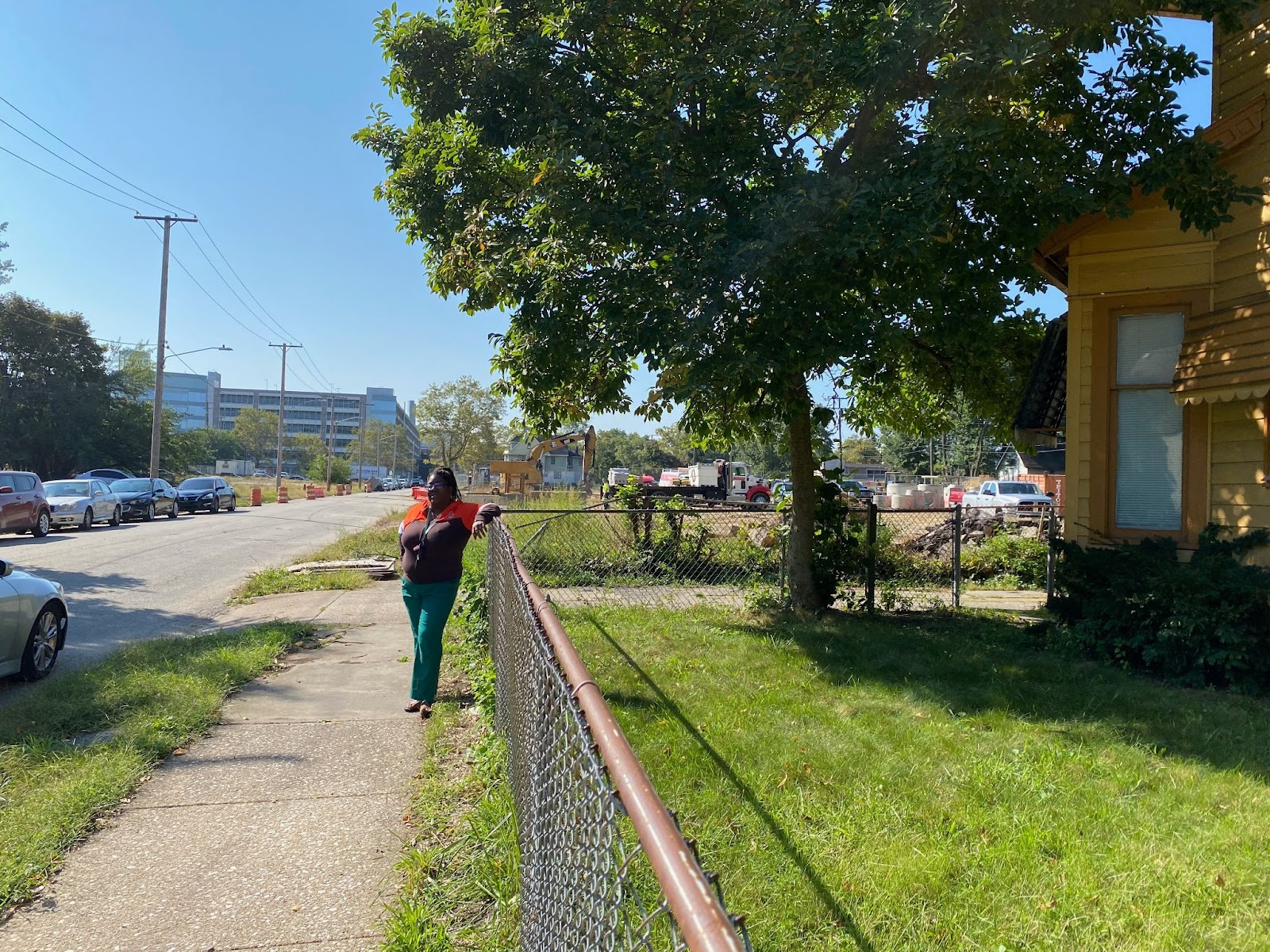
Patricia White just outside her home (right) located near the Cleveland Clinic (back left) and new construction (back right.)

“This sickens me,” said Patricia White, whose house abuts a new development. She said her father lived in the apartment complex formerly on the site, which fell into disrepair in the 1990s. “There isn’t a whole lot of affordable housing.”

All properties given to the land bank or foreclosed upon by the government in Cuyahoga County. Graphic credit: Eye on Ohio, the Ohio Center for Journalism

Looking Back

According to the National Land Bank Network at the Center for Community Progress, there are over 200 land banks nationwide. Eighty-two of those are Ohio county land banks, and several Ohio cities have land banks as well.

Land banks started in Colorado in the 1970s. They were later adopted, particularly in rust belt communities, which kept expanding their reach. In 2009, Ohio passed S.B. 353, allowing a “new breed of county land bank.” In the words of creator Gus Frangos, they became land banks “on steroids.”

“This new class of CIC— a county land bank— not only embraces economic and industrial development, but also community development, which is often necessary to jump start or ‘set the table’ for economic development,” Frangos wrote in a 2018 continuing legal education course on land banks.

Land banks now are vital public agencies. They turn decrepit, often-abandoned properties into viable homes – before they attract pests and crime.

Various studies show they may stabilize housing prices. And very little funding comes from taxpayers.  The bulk of their revenue flows from tax-delinquent properties.

“The key problem in a place like Toledo is the changes that happen in industrialization. We just have too many buildings for our community. So in 1970, the city of Toledo had 384,000 as a population. By 2019, that number had dropped to 273,000. So we saw an over 25 percent diminution in the population in 50 years. Now, it’s econ 101 to recognize that if you have housing for nearly 400,000 people but only humans close to 300,000, you have an oversupply in housing and insufficient demand. So the thing that the land banks did, by altering the number of properties within the city, they drove property values back up,” said Shelley Cavalieri, a property law professor at the University of Toledo.

“Distressed properties lower the sale of nearby homes by something like 5 percent. When the land bank takes possession and does some basic mowing and boarding, it reduces that by about a percent. Once a demolition goes through and a vacant lot is owned by a land bank, it reduces that by another 2 percent.”

But land banks have also created tension between officials with more decrepit properties than they could ever remediate versus residents who always consider their neighborhoods a top priority.

That gripe is particularly loud for land bank recipients perceived to have cut in the line.

In 2018, the Cuyahoga County Land Bank gave Coventry Park Apartments on Superior Road to Coventry Park Apartments, LLC, a company owned by Steven Pontikos, Gus Frangos’ nephew. Pontikos later sold it for $1.5 million.

In 2014, the land bank also gave a property to 14078 Superior, LLC, another Pontikos-owned entity. In 2021, the LLC deeded it to Pontikos personally for $0.

East Cleveland gave Pontikos two properties in 2017. He transferred them in 2019 to his solely-owned entities: 14048 Superior, LLC and 1520 Belmar, LLC .

In 2012, the land bank gave a parcel to East Cleveland, which again gifted the land to Pontikos in 2017. Once more, he transferred the parcel to his solely-owned 14042 Superior, LLC in 2019. East Cleveland, Pontikos- and Frangos did not respond to requests to comment.

The Cuyahoga County land bank said they have a detailed conflict-of-interest policy.

“The Cuyahoga Land Bank evaluates available properties on a case-by-case basis to determine whether the acquisition of the property would further the Land Bank’s mission under its agreement and plan with Cuyahoga County. We also take guidance from our community partners such as local government officials, community development corporations, faith-based, and other non-profit corporations that are doing community development work,” said Douglas Sawyer, Assistant General Counsel for the Cuyahoga County Land Reutilization Corp.

“The Coventry Park Apartment properties you are referring to were forfeited to the State of Ohio after they went through tax foreclosure and did not sell at sheriff’s sale. Mr. Pontikos’s company contacted the Land Bank and expressed interest in acquiring the properties through the Land Bank so that his company could renovate the properties and get them back into productive use.”

Land bank staff found Mr. Pontikos well qualified and financially capable of undertaking the large amount of work necessary to get these properties renovated and productive again. Land Bank staff knew Mr. Pontikos was an extended relative of Mr. Frangos and concluded that this fact did not disqualify his otherwise-qualified company from transacting with the land bank.

“In exchange for the company’s promise to renovate the properties, the land bank agreed to acquire the properties from forfeiture and sell them to the company for a total of $50,000. (The county’s website show a sales amount of $0 because transfers out of a county land reutilization corporation are exempt transfers and therefore no sale price is inputted by the county at time of transfer). The properties were successfully renovated and now generate almost $85,000 per year in real estate taxes. Transfers such as this one are exactly what the Land Bank is charged with doing – getting distressed tax foreclosed and forfeited properties back into productive use,” he wrote.

Dayton

In Montgomery County, of 34,627 delinquent parcels in 2018, less than 1 percent (281) went to the land bank or were taken by the city in tax foreclosure by late 2021. Two hundred seventy-eight of those properties owed money, with a median $4,049 and an average of $9,395.

Yet of the top 281 worst offenders that year in terms of the amount of taxes owed, just seven were actually foreclosed upon. Those parcels owed an average of $78,207 and a median $53,577. Three years later, 80.9% of them are still delinquent.

Unlike Cuyahoga County though, in Montgomery County, for two parcels owing approximately the same amount, proximity to the most-expensive real estate didn’t matter— and neither did the racial composition of the school district. The net amount of delinquency wasn’t practically significant.

All properties given to the land bank or foreclosed upon by the government in Montgomery County. Graphic credit: Eye on Ohio, the Ohio Center for Journalism

Cincinnati

Hamilton County had the weakest relationship between the amount owed and later entry to a land bank. The median amount owed for land bank properties was lower, $407, than the median for those not going to a land bank, $1,025.

And again, between two parcels owing the same tax debt, those in majority-white school districts were more likely to get picked.

All properties given to the land bank or foreclosed upon by the government in Hamilton County. Graphic credit: Eye on Ohio, the Ohio Center for Journalism

Columbus

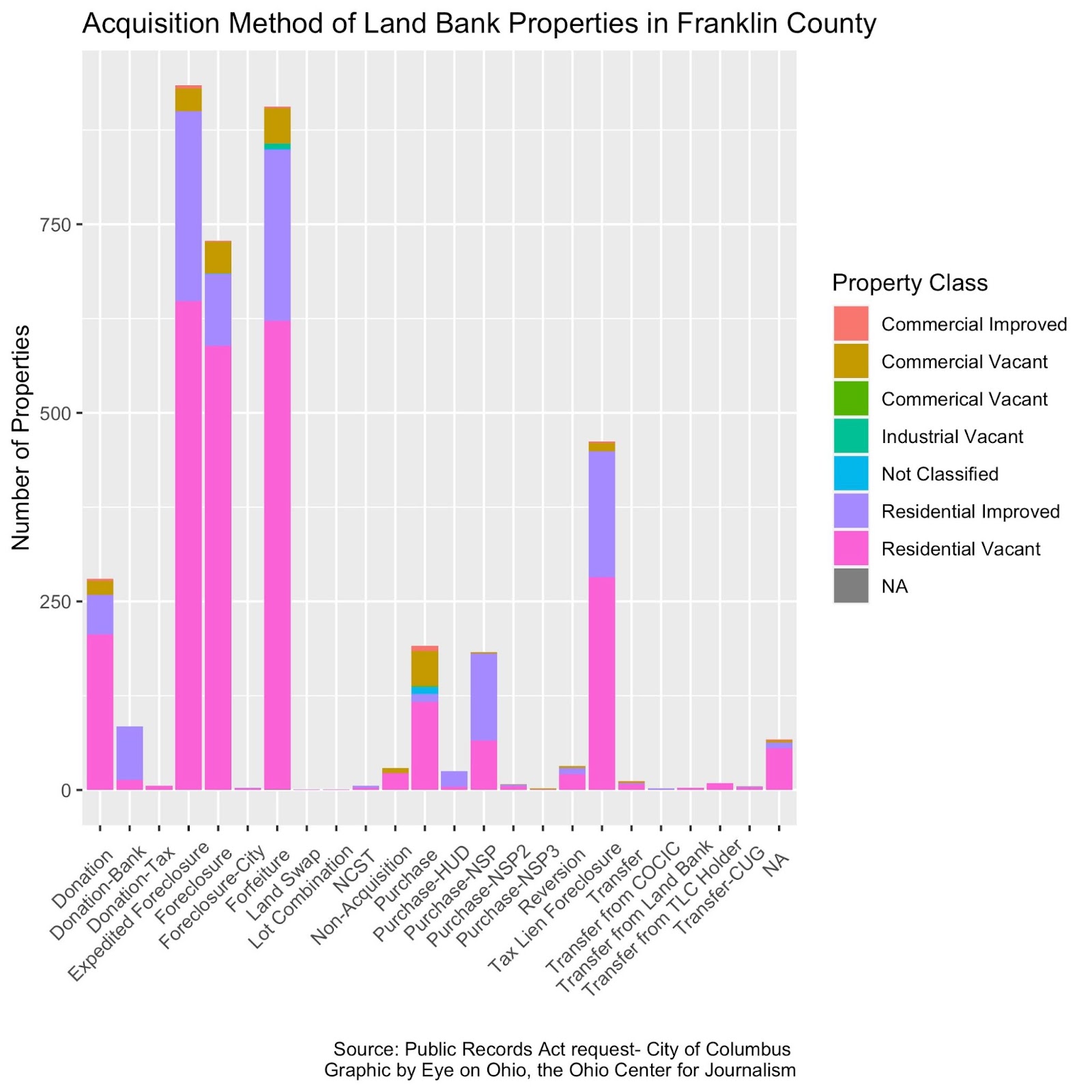
Despite Columbus’ population, the Central Ohio Community Improvement Corporation-Franklin County Land Bank has remediated far fewer properties – 3,979 as of publication. But Columbus has had the opposite problem with its housing stock: a growing population and too few houses, particularly affordable ones. According to the U.S. Census, between 1970 and 2020, Cuyahoga County’s population dropped 26.5% from 1.7 million to 1.3 million. Franklin County, in the same time period grew 58.9%, from about 800,000 to 1.3 million.

All properties given to the land bank or foreclosed upon by the government in Franklin County. Graphic credit: Eye on Ohio, the Ohio Center for Journalism

Franklin County saw 70 percent of all Ohio’s population growth in the last decade, according to the latest Census. Columbus’ growth rate in the last decade, 15.1%, surpassed even fast-growing metropolitan areas such as D.C. (14.8%), Nashville (14.7%), Portland (11.8%), Phoenix (11.2%) and Las Vegas (9.9%). In that time, 39% of vacant and abandoned housing disappeared in Franklin County.

Of the 63,685 unique parcels behind on property taxes in the past three years, just 490 went to the land bank, 187 of which still exist to geolocate.

The majority (150) were in minority school districts. But among homes owing the same amount, parcels in majority-white school districts were more likely to go to the land bank. So were parcels within a mile of a parcel worth at least $10 million.

The city has targeted certain areas such as Linden, but that doesn’t mean they can fix the affordable-housing problem, said Michael Wilkos, Senior Vice President of Community Impact at the United Way of Central Ohio, who studies population shifts to see where to send donation dollars.

“Every single structure can be saved if you want to put a lot of money into it. But there are market constraints on that. There was a lot of housing stock in Linden that had been vacant for so long that it had deteriorated to the point where its salvation was unlikely, ” he said.

Wilkos said that unaffordability comes from chronic underbuilding in the Columbus area for the past decade and not enough wage growth to catch up to rising rents.

“Relative to other neighborhoods, the West Side is still a bargain. And there’s still a lot of vacant lots and a lot of vacant houses on the West Side. That’s where an organization like the land bank can really shine. How can we as a community have some vacant lots, constructed with houses, and bring some vacant houses back to life? How can we keep them affordable? So you don’t experience gentrification. So that’s why I can say with a high level of support, Columbus needs a strong land bank.”

Sidebar: What is Artificial Intelligence and why use it to look at public records?

Jim Crowley, Ron Calhoun, Sara Stoudt, and Rich Weiss contributed to this project.