CityVoiceCLE Local updates. Clear action.

Juneteenth 2024 at the African American Cultural Garden

By Obie Shelton

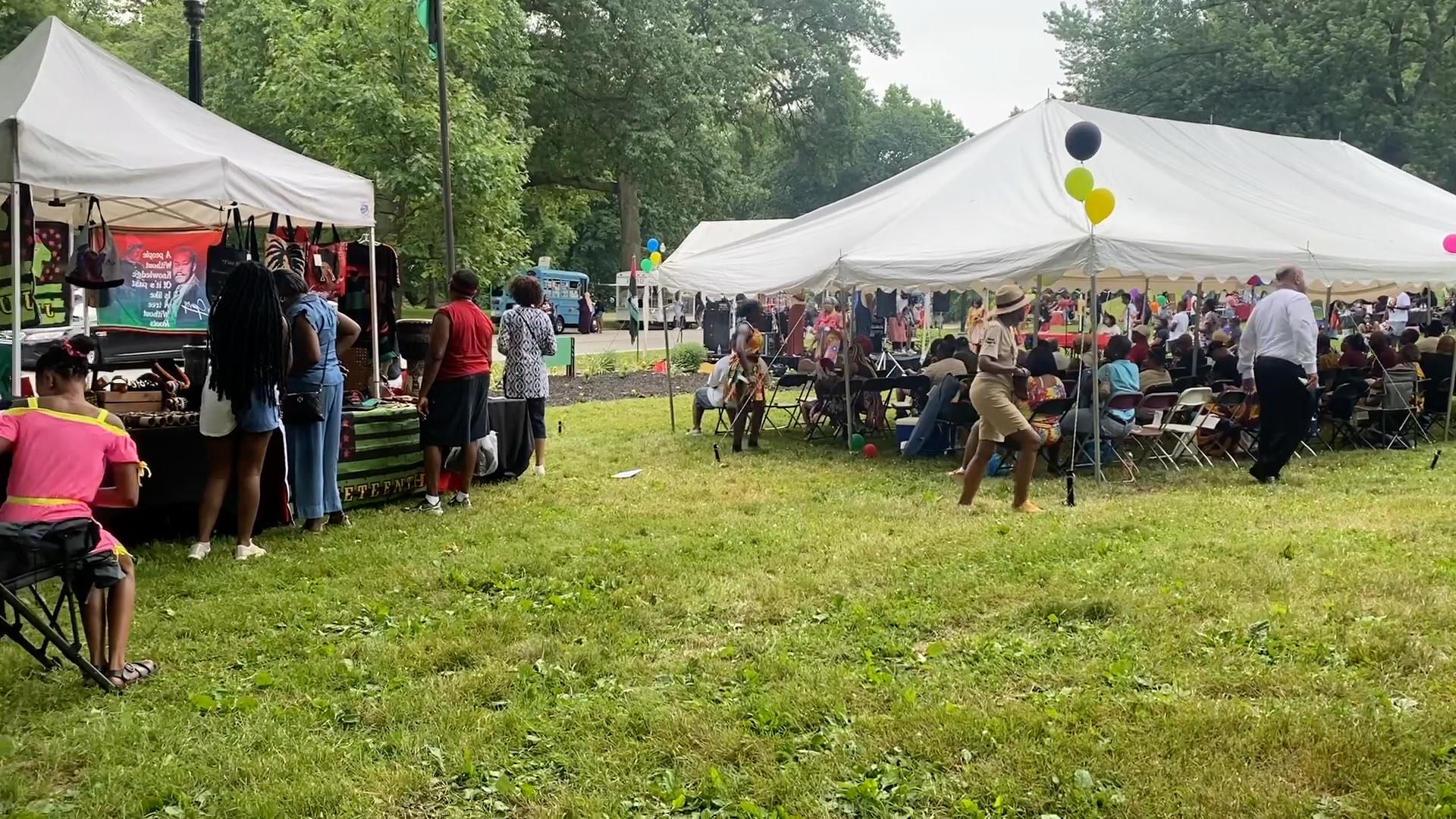
The heat was on, but the rain held off as more than 200 people visited the African American Cultural Garden to celebrate the Juneteenth holiday. 

“This is what it’s all about—community,” said organizer Beverly Lloyd. 

Martin Luther King Boulevard was closed off between Superior and St. Clair from noon until 4 p.m. to give full access to the celebration as the temperature soared to 90 degrees.

Live music was provided by the band Loladé. The band features David Clark, Jerrell White, Sha’Nyla Curry, and Lolade’ Mccants. 

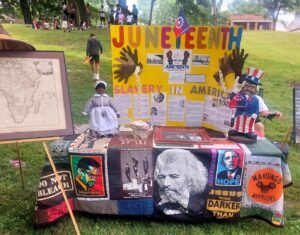
The Cleveland Cavaliers sponsored a talent show competition of young people performing songs, dance, and spoken word. Cash prizes were given to winners. A dramatic presentation reenacted the day enslaved people in Galveston, Texas, were informed by a Union soldier that slavery had ended in the U.S.

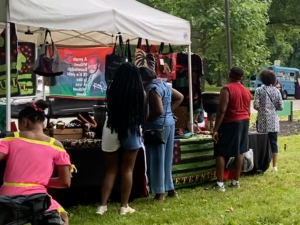
Free food was served in the tradition of Juneteenth. Barbecued chicken, Jollof rice along with red beans and rice were served with watermelon and hibiscus red tea. The red-colored food is recognized as symbolizing the bloody struggle, sacrifice, and resilience of enslaved Africans in America. Vendors sold African-themed clothing and artifacts while books were given away to children who listened to storytellers.

The Cultural Garden’s executive director Obie Shelton urged those in attendance to spread the word about the importance of raising the rest of the money to complete the garden. “We can each contribute,” he said. “It’s not about waiting for someone else to do it for us.” 

The garden’s fundraising campaign has secured almost half of the $4 million needed to complete the dramatic granite and sandstone design that will stretch down the hill from Wheelock Avenue to Martin Luther King Boulevard. “Let’s finish it,” Shelton said.

The African American Garden site was dedicated in 1977. The completed African American Cultural garden will convey the journey of the African American community from the past through the present and into the future.

Legal Aid provides help for clients struggling with mental health

By Tonya Sams
Many people suffer in silence when struggling with mental health issues. These issues can affect every area of one’s life—even how they address legal issues that impact basic needs like shelter, safety, and economic security. Client Support Specialists at The Legal Aid Society of Cleveland recognize how a client’s battle with mental health challenges can impact their legal cases. People work with Legal Aid attorneys to implement strategies to help them have positive case outcomes while improving mental health outcomes.
“Client Support Specialists are professionals who provide assistance and support to those who are receiving legal assistance from Legal Aid who may have a barrier related to their legal case,” said Aisha Midgett, a Client Support Specialist at Legal Aid. The Client Support Specialists at Legal Aid make a team of three trained social workers. For over a decade, Client Support Specialists, working closely with attorneys and paralegals, have played a critical role in ensuring the best possible outcomes for client success and overall wellbeing.
When mental health issues are involved, it can dramatically affect a client’s case.
“It can have a significant impact in various ways,” said Aisha. “It can affect their ability to make informed decisions, their ability to understand the legal process and legal language. They may not have the ability to engage with their case, so they are missing appointments, won’t return calls, or won’t follow through on tasks.”
To help clients resolve these issues, Aisha and other Client Support Specialists at Legal Aid will conduct an intake to determine the obstacles that may cause the client not to be actively involved in their case. They help identify the client’s needs, establish goals to help them along the legal process, and link them to community resources and programs that may help them with their mental issues. Many of these resources and programs offer crisis prevention, suicide resources, crisis hotlines, and educational information.
People with low income experiencing mental health issues may have additional challenges when it comes to finding proper assistance. This may be due to limited access to therapists, counselors, or case management professionals.
Beyond the financial barrier to accessing care, “There is a social stigma about sharing mental health issues with people which hinders their ability to have access to health resources,” said Aisha. “There are also other challenges. People could be struggling with substance abuse, domestic violence, and trauma. They could also be dealing with chronic health conditions. All of these things overlap which can heighten the possibility of being exposed to mental health challenges.”
Client Support Specialists also assist with crisis intervention for clients who have experienced a crisis or are at risk by creating a safety plan. Safety plans are unique to each individual. They are designed to help them feel safe, and connected to people experiencing a crisis. For some people, this could be a sheet of paper that includes information from emergency organizations, local hospitals, and others they can contact when they are in a crisis. It can also include information on coping skills.
“There are clients that never talk about their feelings, but we give them access to help and get them linked to organizations to receive mental health services that will work with them on a longterm basis to improve their mental health,” said Aisha. “Remember, it is okay to ask for help. You are never alone.”
Do you need help with a civil legal matter? Legal Aid may be able to help.  Call Legal Aid at 888-8173777 during normal business hours, or contact us online 24/7 at lasclev. org/contact/.
Tonya Sams is a Development & Communications Manager at The Legal Aid Society of Cleveland.

Book Review: America’s ‘Nap Bishop’ Offers Strategies for Rest As Resistance

By Sheila Ferguson

Tricia Hersey is the New York Times best-selling author of “Rest is Resistance: A Manifesto.” The Atlanta, Georgia-based theologian, artist, poet, life coach, and community organizer is the self-anointed “Nap Bishop.” Since 2016, she has shared a compelling message about the power of rest to break the cycle of oppression.

The book reads, “Your body is a site of liberation. It doesn’t belong to capitalism, Love your body; Move your body and Hold your body.” 

“Nap Bishop” followers believe that taking a break from burnout is lifesaving. They see rest as a pathway to revitalizing your life. Hersey’s book, “Rest Is Resistance: A Manifesto,” published by Little Brown Spark (2022), focuses on two points: giving yourself permission “to live the ‘soft life’ through rest and restoration, and “quiet quitting” the corporate grind and releasing academic pressures that cause fatigue and social and emotional oppression.

Hersey’s views come from her years of struggle as a graduate student at the Candler School of Theology at Emory University. Those were tough years, she recalls. As a grad student of humble means, Hersey was crushed by financial burdens, daily travel on public transit, and the grind of studying tirelessly with little to no sleep. She also cared for an ill family member. All of these pressures were compounded by the COVID-19 pandemic and the horrors of racism in America. 

Out of the struggle, exhaustion led Hersey to take daily naps, to daydream, and to have periods of rest and respite. Experiencing this burnout, and the refreshment gained from these simple lifestyle changes, gave birth to Hersey’s Nap Bishop ministry.

The author’s core message is that Black people’s exhaustion stems from a legacy of enslavement, Jim Crow segregation, and modern-day racism. More importantly, Hersey says the recovery of Black people depends on the remembrance of the following:

  • Watching our elders rest by reading scripture, meditating, and resting their eyes or feet daily to rejuvenate and renew
  • Knowing that allowing rest, sleep, naps, and daydreaming slows us down enough to awaken to the beauty in ourselves
  • Releasing ourselves from the grind to resist the capitalist and white supremacist mind

Hersey also stresses that rest is necessary and natural for all of us. Without rest, she says, “we won’t make it! Thus, collective rest will liberate us and shift our consciousness.” Hersey gives the message of rest as resistance with the intent of undoing the harm of exhaustion done to Black bodies. In her words, it starts by moving away from society’s demand for perfection and beliefs.

Today, you can read Hersey’s message in book form, watch and listen online, or attend her live sessions. During live sessions, the author preaches and leads meditation while the participants experience a state of collective rest. Hersey works to jar people enough to wake up through sleep.

Rather than using free time to do extra work, Hersey’s movement inspires people to sleep and rest to stave off burnout, exhaustion, and the risks of premature death. It is also a tool for helping others recognize their full potential beyond fulfilling the role of a slave to society’s demands for mass production and speed in delivering work products.

The How-Tos of Self-Liberation From Obtaining Rest

Though daily sleep and rest are the starting points of Hersey’s theory, healing and self-liberation are its endpoints. She says getting there requires that you:

  1. Stop worrying and reflect on your needs for peace and comfort. It’s about collectively refusing to run ourselves into the ground.
  2. Rest and reset for good health.
  3. Use rest as a form of resistance against oppression because it is life-saving and liberatory.
  4. Start a daily practice of daydreaming.
  5. Know that change takes time.
  6. Slow down, connect, and reimagine your life.
  7. Know that you are enough.
  8. Know that exhaustion is not productive.
  9. Listen to yourself and others more.
  10. Create systems of community care and support.

Daily Resting Practices

Finally, begin and continue a practice of valuing self and the grace of loving yourself by:

  • Closing your eyes once or twice daily,
  • Taking long showers in silence,
  • Meditating on the couch for 20 minutes,
  • Daydreaming by staring out the window,
  • Sipping warm tea before bed in the dark,
  • Slow dancing with yourself to slow music,
  • Taking a twenty-minute timed nap,
  • Praying daily,
  • Taking regular breaks from social media, and
  • Committing to deep listening and enjoying musical albums.

To learn more about Tricia Hersey’s work as the Nap Bishop, search these titles on YouTube:

Tricia Hersey: Rest & Collective Care as Tools for Liberation 

Tricia Hersey: Creating a Guided Meditation for “Promise, Witness, Remembrance” 

NO MORE GRIND: HOW TO FINALLY REST WITH TRICIA HERSEY – WCDHT EP 139

State of the Arts vs. State of the City. What gives?

By Vince Robinson

Recently, there was a City Club of Cleveland event called The Changing Landscape of Arts and Culture in Northeast Ohio which featured a question and answer session conducted by Rhonda Brown, Chief Strategist for Arts, Culture and the Creative Economy with Jeremy Johnson, President and CEO of the Assembly for the Arts. The Assembly is a non-profit arts advocacy and research organization that provides support for artists, non-profits and creative businesses in Cuyahoga County.

According to an economic impact study by Americans for the Arts, Cuyahoga County’s nonprofit arts and culture industry generated more than $533 million in economic activity in 2022, a fact mentioned by Johnson. “Even in the aftermath of the pandemic, we were a half billion dollar industry, just in Cuyahoga County, just in non-profits. I’m not even talking about those other legs, individual artists, creative businesses. When we put all of that together, we are a powerhouse and we must continue to be that powerhouse.”

He spoke of the importance of the current levy that supports the arts through a tax on cigarettes which will expire without support from voters to extend it. “We are unique in the country. We have a special levy that only supports the arts community, the non-profit arts community. It’s twenty years old. It has delivered 4,000 grants to a quarter-billion dollars and we can’t let that go away.”

Johnson came back to Cleveland after working in Newark, New Jersey as Executive Director of Newark Arts. He became President and CEO for the Assembly for the Arts in 2021.

Said Johnson, “What I’ve learned in years of working in public/private sector is there’s gotta be collaboration. There’s got to be partnership. There has to be people that invest in that glue, knowing that our city leadership is working with the arts sector, know that our county leadership is working in partnership. Knowing that philanthropy is at the table. What excites me about Cleveland is all these partners are coming together.
Both Brown and Johnson spoke with clarity about the breadth of artists and genres in our community, not limiting their scope to visual artists but including the wide range that includes performance, literary, culinary, fashion, and many others.

Ironically, this state of the arts conversation was preceded by a State of the City address by Cleveland Mayor Justin Bibb a few weeks prior. In his speech, the mayor spent considerable time in his nearly hour-long comments detailing measures to address public safety, almost 20 minutes to be exact. Cleveland now has 52 cadets in its current police academy. It’s larger than the four previous iterations combined, although published reports indicate that 3 recruits have dropped out.

He mentioned ShotSpotter, a technology for gunshot detection. $10-million has been spent on that thanks to funds from the American Rescue Plan Act which saw a windfall of $512-million for city coffers due to the pandemic. Add to the public safety budget another $2.3 million for new dash cams, $26 million for public safety equipment, and $10 million for a Violence Prevention Endowment Fund. All of these go in to the pot of funds earmarked for the city’s public safety budget of $400 million, which is nearly 54% of the city’s total operating budget for 2024.

Last year, the Assembly for the Arts encouraged city leaders to consider appropriating $10 million dollars to support arts and culture in Cleveland. An appropriation was made after months of others pleading their cases for appropriations for various things. $3 million was earmarked for art and culture from the federally funded gift to Cleveland, amounting to .5% of the total ARPA amount.

Those dollars have been provided to the Assembly for the Arts for a grant program called the Transformative Art Fund, a project-based idea that will award $250K to $500K grants in artist/artist teams and institutional partners who’ll serve as fiscal agents to create in Cleveland neighborhoods in the coming year.

It is important to note that the City of Cleveland legally cannot provide direct support to artists in the way that it does public safety personnel. As a result, the Assembly for the Arts is serving as the custodian of the funds that will be given to the institutional partners to provide to the artists to carry out their projects.

These projects promise to have a transformative effect in many ways, as they speak to the ability of artists to address the needs of people and create modalities that foster healing, grief recovery, boost self-esteem, improve the environment and most critically, address racism as a public health crisis.

The real tragedy here is that in the minds of many people, politicians and the general public, public safety has been the primary concern at the expense of the power of art to be the answer to our insecurity about existence.

We are willing to accept tax dollars being spent on tracking gunshots and recording encounters with the police who are hired to protect us from each other and respond to the results of trauma and human dysfunction. This is seen as an alternative to the proactive approach of engaging human beings in the practice and process of creation and engagement in art as a means of self-love, empowerment and edification.

We live in a city in which only a few students get exposure to the arts and a majority go without the benefit of art and culture in their classrooms. Many of the these students end up in the pipeline to prisons where ironically, some find themselves saved by art.

The definition of insanity involves the idea of doing the same thing over and over but somehow expecting a different result. The current model of addressing the ills of our society is insanity. Only when the approach is changed will we see significant change. In the interim, racism will continue to be the public health crisis that goes largely unaddressed as we live in fear of each other and demand Cleveland hire more police officers.

Art is at the heart of possibilities to impact lives in a meaningful way. Only when this is understood and embraced by the people who make the decisions about how our tax dollars are spent can we realize those possibilities.

Now is the time.

Bills Pending in Ohio Legislature Seeks to Uplift Black Community

By Gregory Moore

There are a number of bills pending in the Ohio Legislature that could have a profound impact on African Americans in the state of Ohio. Many of these bills are tied to longstanding issues related to closing the education, health, and wealth equity gaps that have existed for Black communities in Ohio for decades.

Members of the Ohio Legislative Black Caucus (OLBC) led by its president, Cleveland’s own State Representative Terrance Upchurch, (D-20th) have been working at the statehouse in Columbus for years to address many of the social, economic, and political empowerment issues that impact the Black Community in Cleveland and across the state.

The OLBC has also served as the leading opponent to an array of regressive legislative proposals that have been advanced by the heavily Republican-dominated House and Senate since 2011. The OLBC focuses on several bills ranging from criminal justice reform, increasing educational opportunities in higher education, promoting equity in funding K-12 schools, access to affordable health care, and a series of bills that promote economic development in the Black Community.

One of the most powerful vehicles that assist the members of the legislature and other advocacy groups in addressing these public policy issues is the Ohio Legislative Black Caucus Foundation, (OLBCF), a separate non-partisan 501 (C) (3) research and policy organization. Since taking over OLBCF in November 2023, the foundation’s new president Shayla Davis and her team have been focused on monitoring a number of key bills, and actively engaging with legislators and state officials to ensure that the concerns and interests of Black Ohioans are adequately represented.

OLBCF also provides research and public policy support for OLBC members and other stakeholders across the state who share in their mission to address critical issues related to African Americans. Davis highlighted several pending bills being tracked by the OLBCF that are often overlooked by media outlets but can have a profound impact on the lives of Black Ohioans if passed into law.

Economic Empowerment
Rep. Terrance Upchurch (D) (OH-20) helped lead a successful bi-partisan effort in the Ohio House to pass H.B. 2 the Direct State Funds for Economic Growth and Community Development Act which would redirect $2 billion of new state funds for construction and economic development projects that prioritize community investments. If passed by the Ohio Senate, H.B. 2 would help generate economic growth and increase employment opportunities in the state’s most underserved communities. H.B 2 includes restoring $700 Million from the One Time Strategic Communication Investments Fund (OTSCIF) that was set aside in the most recent state operating budget.

Health and Wellness
Rep. Latyna Humphrey (D)(OH-2) has introduced H.B. 7, the Strong Foundations Act which modernizes the enrollment and benefit distribution process for families to have their benefits from the Special Supplemental Nutrition Program for Women, Infants, and Children (WIC) added to their Electronic Benefits Transfer (EBT) card virtually. Previously transfers could only be made in person.

A report by the Health Policy Institute of Ohio for the last decade showed infant mortality has gradually gone down overall, but for Black Ohioans, the rate is still 164% higher than for white Ohioans. Black women disproportionately face discrimination in traditional birthing environments. H.B. 7 would also enable Medicaid to cover doula services for expectant moms on Medicaid.

Rep. Munira Abdullahi (D) (OH-9) has introduced HB 384, the Cap Cost Sharing for Prescription Insulin Drugs, Diabetes Devices Act. A recent Center for Disease Control and Prevention study revealed Black insulin users are more likely to report rationing insulin at 23.2% higher than white diabetics. Even with health insurance coverage, monthly insulin costs can be beyond the reach of many seniors and diabetics on fixed incomes.

Criminal Justice Reform
Ohio Sen. Catherine Ingram (D) (OH-9) has introduced S.B. 37, the Regards Driver’s License Suspension Law; Financial Responsibility Act which removes several offenses as reasons to suspend driver’s licenses including a penalty of a suspension for certain drug offenses and for outstanding financial obligations. A 2022 report released by the Cleveland Legal Aid Society revealed that approximately 60% of all Ohio driver’s license suspensions are based on a person’s failure to pay money owed to a court, to the Ohio BMV, or to a private third party, including child support. S.B. 37 seeks to address the impact of a Driver’s license suspension impeding on their ability to make income and pay restitutions for their financial obligations.

Rep. Juanita Brent (D) (OH-22) has introduced H.B. 178, the Creating a Respectful and Open World for Natural Hair Act, a bill similar to the federal Crown Act. Race-based hair bias and discrimination is a systemic problem that disproportionately impacts Black people, particularly Black women. A 2023 study by Dove Soap and LinkedIn revealed that Black Women’s hair is 2.5x more likely to be perceived as unprofessional and 25% of Black women believe they have been denied a job interview due to their hair.

Rep. Latyna Humphrey (D) (OH-2) has also introduced H.B. 44, the Require Electronic Recording of Parole Board Hearings Act to facilitate access to and transparency in parole board hearings. The bill aims to improve criminal legal systems through transparency and accountability.

Ohio Rep. Dontavius Jarrells, (D) (OH-1) has introduced House Joint Resolution H.J.R. 2 the Prohibit Slavery or Servitude as Punishment for Crime. The Resolution would eliminate the archaic exception to slavery in Ohio’s constitution by proposing to amend Section 6 of Article I of the Constitution of the State of Ohio to prohibit slavery or involuntary servitude in Ohio for the punishment of crime.

OLBCF’s Davis highlighted these bills as just a few examples of the efforts of Black lawmakers to “move the needle” in the area of public policy. “We know that systemic racism remains as the root cause for many of the barriers that exist today. Our efforts are centered around dismantling these barriers and advocating for addressing racial disparities through public policy.”


WWE’s SummerSlam Returns to Cleveland in August

By Izzy Aparicio
Get ready, wrestling fans! The WWE SummerSlam event will return to Cleveland for the first time in 28 years. There will be many events such as the Friday Night SmackDown at the Rocket Mortgage Fieldhouse on Aug. 2 and the main event on Aug. 3, as the action explodes inside Cleveland Browns Stadium.
Prepare for a week-long takeover by WWE, featuring not only these marquee matches but also a variety of fan and community events designed to immerse the city in the world of professional wrestling.
The highly anticipated card and ticket details are yet to be revealed. Stay up to date using the official WWE website for updates and pre-sale registration opportunities.
Recently, the WWE received TV and film production tax credits from the Ohio Department of Development, which may be one of the many reasons the WWE chose Cleveland as the host for the 2024 SummerSlam.
Last year’s SummerSlam in Detroit shattered attendance and viewership records. Cleveland anticipates replicating this success, expecting the upcoming event to be the largest WWE production ever held in Ohio.
Cleveland is quickly becoming one of the major cities to hold conventions with events like the SummerSlam and FanExpo, which happens in late April. This influx of visitors will not only create excitement but also contribute positively to the city’s economic well-being.

Cleveland Fire Boat For Sale

The Cleveland Anthony J. Celebrezze Fire Boat, named after the 49th mayor of Cleveland, is up for sale. Asking price starts at $5,000.

The boat, which was on the scene in 1969 when the Cuyahoga River caught fire, was decommissioned on June 28th, but still has potential. The engine measures 61 feet long and 16′ wide. In a recent Cleveland.com article, Cleveland city councilman Mike Polensek said, “The Anthony J. Celebrezze Cleveland Fire Boat has served the city well but has become outdated.” The boat has been replaced with a newer boat called the Garrett Morgan Fire Boat, and Polensek further explained that “The Garrett Morgan fire boat, with newer technology, has the capacity to respond quicker and to pump more water.”

Thank You Cleveland Foundation!

The Cleveland Foundation (TCF) has awarded The Cleveland Observer (TCO) a grant from its Cleveland Black Futures Fund. The Fund supports Cleveland-based nonprofit organizations that are both Black-led and Black-serving. TCO staff and Board members wish to thank the Cleveland Foundation and their partners for this great resource, in furtherance of building a non-profit media/publishing company.
The mission of The Cleveland Observer is to engage, educate and empower the communities we serve. But for the grace of God, and the funding provided by Neighborhood Connections and the Cleveland Foundation, TCO would not exist. On behalf of all of us at The Cleveland Observer – Thank You!

Ron Calhoun, President and Publisher
The Cleveland Observer

Neighborhood Pets Health Fair in Slavic Village

By Ashley Malaney and Megan Rospa

Neighborhood Pets is a nonprofit organization based in Slavic Village with a seemingly simple mission: Take Care Of Each Other. But in their almost seven years of work and relationship-building in the community, they have seen a growing need for their services that is only increasing.

Recognizing the important benefits of the human-animal bond, Neighborhood Pets works to help keep pets in their homes. To do this, they provide low-cost wellness pet care and supplies, a free spay-neuter program, a pet food bank, veterinary care assistance, and more to pet owners in need in Cleveland. When you hear that list, you may not assume that Neighborhood Pets also has partnerships with human-focused social service agencies in the area.

Ashley Malaney, the project & outreach coordinator at Neighborhood Pets, emphasized the work they’re doing to grow relationships with other organizations in Cleveland. “What we have learned is that people care so deeply about their pets, that they will come to us for help for their pets before getting help for themselves,” she said. “Because we are building trust and rapport with our clients, they typically tell us more about their other needs as a result. We have a unique opportunity to reach folks who may not be comfortable looking for help on their own, and as a result, we feel we are called to support our clients in finding the resources they need for a better quality of life for themselves and their pets.”

Neighborhood Pets isn’t the only organization that senses this need to bring human resources to the neighborhood. In June, they partnered with University Settlement to create a health and safety fair that was free and open to the public. “We wanted to not only give our community a chance to meet the organizations that are there for them, but we also wanted the organizations to meet and learn about what each other does. We all know that the more we work together, the easier it is to get things done, create change and powerful outcomes,” said Malaney. Participating vendors included health and safety organizations from the Cleveland area that specialize in harm reduction, legal support, medical and dental care, food, and housing assistance. These organizations set up booths on the sidewalks surrounding Neighborhood Pets and in their courtyard. With hundreds of Clevelanders in attendance, free lunch and refreshments were provided for all participants by The Centers, University Settlement, and Neighborhood Pets.

Neighborhood Pets also collected hygiene and first aid products, baby care items, some seed starters, and other items from the Goods Bank NEO to give to clients for free. The participating vendors were University Settlement, Legal Aid, MetroHealth, The Centers, NEON (Northeast Ohio Neighborhood Health), NORA (Northeast Ohio Recovery Association), Thrive 4 Change, and Care Alliance. Approximately 300 people attended, many of whom were clients of Neighborhood Pets; however many neighbors and other community members also stopped by to participate in the event.

The simple mission of “Take Care of Each Other” was embodied by all who attended, and due to the strong attendance, Neighborhood Pets has committed to hosting these events on a regular basis to help any Clevelanders in need.

To learn more about Neighborhood Pets Outreach and Resource Center, visit their website at www.neighborhoodpetscle.org, or visit their Facebook page at www.facebook.com/neighborhoodpetscle.


The Cleveland Cavaliers: Summer League Champions

By Anthony Byrd

In the championship game of the 2023 NBA Summer League, the Cleveland Cavaliers demonstrated a level of team play that left basketball fans in awe. From the opening tip to the final buzzer, the Cavaliers exhibited a seamless and harmonious performance, showcasing their collective strength and unity on the court. The Cavs annihilated the Houston Rockets in a 99-78 game blowout. The Cavs were a force on the defensive side of the ball as well. They communicated effectively, seamlessly switching assignments, and providing help on defense when necessary.

The potential of Emoni Bates already began to show itself on the court. In these 6 summer league games, he averaged 17 points per game, 6 rebounds per game, and shot an efficient 40% from deep. Isaiah Mobley’s presence in the post was a key factor in the Cavaliers’ success as well. The power forward dominated the boards, pulling down crucial offensive rebounds that led to second-chance opportunities. Due to his major contribution in the game, Mobley received the Summer League Championship MVP.

The Cleveland Cavaliers’ teamwork, chemistry, and unwavering commitment to each other’s success proved to be the deciding factor in the championship game.