CityVoiceCLE Local updates. Clear action.

Five Things to Know About Who’s Really Cycling In and Out of Cleveland’s Courts

By Wesley Lowery and Ilica Mahajan, The Marshall Project

As part of our ongoing “Testify” series, The Marshall Project scraped years of court documents to understand what happens in Cuyahoga County courts. Our newest analysis examines who cycles repeatedly in and out of courtrooms, prisons and jails, and why. Here’s what we found:

The majority of cases feature defendants with at least one prior charge, and nearly a third have at least five prior criminal cases. The crimes are mostly not violent.

Nearly 70% of the county’s nearly 70,000 criminal court cases from 2016 through the end of 2021 involved a defendant with at least one prior charge on their record. By and large, these defendants come from Cuyahoga County’s poorest ZIP codes. They are almost exclusively male, even more likely to be Black than defendants facing their first charges, and more likely to hail from the city as opposed to the suburbs.

Many of these defendants are not hardened, violent criminals. Most are not committing serious violent crimes that would result in lengthy sentences. Instead, they cycle through the courts every year or two to face the types of charges that earn them probation or brief stints in prison. They serve their time and are released, then wind up back in court again on similar criminal charges.

This article was published in partnership with The Marshall Project, a nonprofit news organization covering the U.S. criminal justice system. Sign up for their newsletters, and follow them on TwitterInstagram and Facebook

Most of the crimes are linked to untreated drug addiction or mental illness, compounded by poverty.

Prosecutors, defense attorneys, judges and legal experts agree that addressing mass incarceration and rising crime will require grappling with this universe of repeat defendants. That is no easy task, requiring a remedy to the decades-long failures to combat the addiction, mental illness and poverty driving crime in Cleveland and across the country.

The analysis shows that these defendants first encounter the court system as teenagers or young adults — the vast majority of them first faced criminal charges before the age of 25 — typically for crimes such as drug possession, petty theft, burglary, breaking and entering, or receiving stolen property. In many cases, their entire criminal records contain only these types of infractions, committed repeatedly between stints of incarceration.

Less than a third of these cases involved a guilty verdict for an “offense of violence,” defined by Ohio as crimes such as domestic violence, escape, improper discharging of a firearm, murder, or arson.

“We understand that prison has not proven to be the solution for stopping repeat offenders,’’ said Brendan J. Sheehan, Cuyahoga County administrative judge, in response to the findings. “At the same time, we have to find more innovative solutions to better protect our communities.” The Cleveland Division of Police and County Prosecutor Michael O’Malley declined to comment on the findings.


Cleveland has specialty courts to consider drug addiction and mental illness — but strict criteria exclude most defendants.

These cases also reveal the current limitations of the county’s “specialty dockets” — side courts that take up some mental health and drug addiction cases. While most repeat defendant cases reviewed by The Marshall Project included a defendant who cited drug addiction, mental illness, or both as a factor in their crimes, almost none of them meet the strict eligibility requirements that have been in place for a case to be handled by Cuyahoga County’s specialty courts.

Has the defendant ever committed a “violent crime”? Then they are ineligible. Previously pleaded guilty to a drug trafficking charge? Ineligible. Been cycling through the system for decades, amassing multiple drug convictions? Ineligible for drug court.

The county will experiment with a new “high-risk” court in coming months.

The coming months will see the county’s most direct effort to work with many of these defendants when the court launches a “high-risk” drug court that will provide services to addicted defendants with lengthy criminal records, even those accused of violent crimes.

Here are some of the people who cycle repeatedly through the courts.

Deshawn Maines, age 52, has been diagnosed with bipolar schizophrenia. His lawyer said he was physically and sexually abused as a child and is addicted to drugs. He’s been convicted of more than 30 crimes — primarily theft and burglary — and suspected in 55 others. Maines’ most recent conviction was for stealing two TVs and a laptop. He said they had been stolen from him, and he was just taking them back. Maines said he’s long had trouble receiving mental health and drug treatment. His attorney believes he was hallucinating, since he was off his medications after an insurance payment didn’t come through. Because of his prior offenses, he was given his stiffest sentence yet — 6 years in prison.

Eugene Groce, 57, has spent decades in Ohio prisons and Cuyahoga County courtrooms. He was first arrested in 1980 as a 17-year-old after a friend of his, he said, snatched a woman’s purse while the two of them were waiting at a Cleveland bus stop. Groce said that by the time of his first arrest he was addicted to drugs and alcohol, having begun drinking heavily at 12. After being released from the juvenile facility, he began using and selling both powder and crack cocaine. For the next 30 years, he cycled in and out of Ohio prisons on charges of theft, burglary and receiving stolen property. He has sought treatment for schizophrenia. All of his offenses, Groce said, were committed in pursuit of his addiction.

Christopher Harvath, 44, has been diagnosed with intermittent explosive disorder, which can result in outbursts of impulsive behavior and violence. He said both his parents were addicted to drugs. At 16, he was sent to a juvenile facility after being caught stealing a car with a group of friends. He’d been sent to prison, ostensibly, to be rehabilitated. Instead, he emerged in 2004 hooked on drugs and has cycled in and out of prison ever since, pleading guilty to charges including breaking and entering, attempted grand theft, grand theft and grand theft auto. He said that at no point during his more than 10 stints in Ohio prisons has he ever been provided with drug treatment or mental health services. His most recent arrest and conviction came after stealing a car, leading police on a chase that ended with a five-car crash. Harvath and two other people were seriously injured. He’s now serving his longest sentence, of 12 years.

Read the full investigation and our previous “Testify” coverage.

Cleveland Has Spent Millions on Police Cameras. Why Are the Locations a Secret?

by Rachel Dissell & Mark Puente

Officials cite citizen safety as a reason for shielding information, but have no policies on use of surveillance technology.

Cleveland has spent at least $7 million to dot the city with about 1,500 surveillance cameras since 2007. It’s poised to invest nearly $4.7 million for 300 more, and fix or replace nearly 40 that are old or damaged.

Unlike other cities, Cleveland officials have refused to share with taxpayers two key pieces of information: where the cameras are, and how they’re used. Some have facial recognition and other capabilities that could compromise privacy if used.

“The cameras are paid for by the public,” Council member Michael Polensek told The Marshall Project. “When they go up, everybody knows where they are at. What’s the secret?”

The city has no policy against sharing camera locations, indicated Karrie Howard, director of public safety. He said the city is prioritizing safety of residents over releasing the information.

“Releasing the locations and capabilities of the cameras has the potential to compromise their effectiveness and will hinder investigations,” Howard said in response to emailed questions.

The stance is at odds with new Mayor Justin Bibb’s commitment to greater transparency and accountability, particularly with the police department.

A spokeswoman for Bibb did not respond to specific follow-up questions, other than noting the mayor was aware of Howard’s responses.

No policies in place

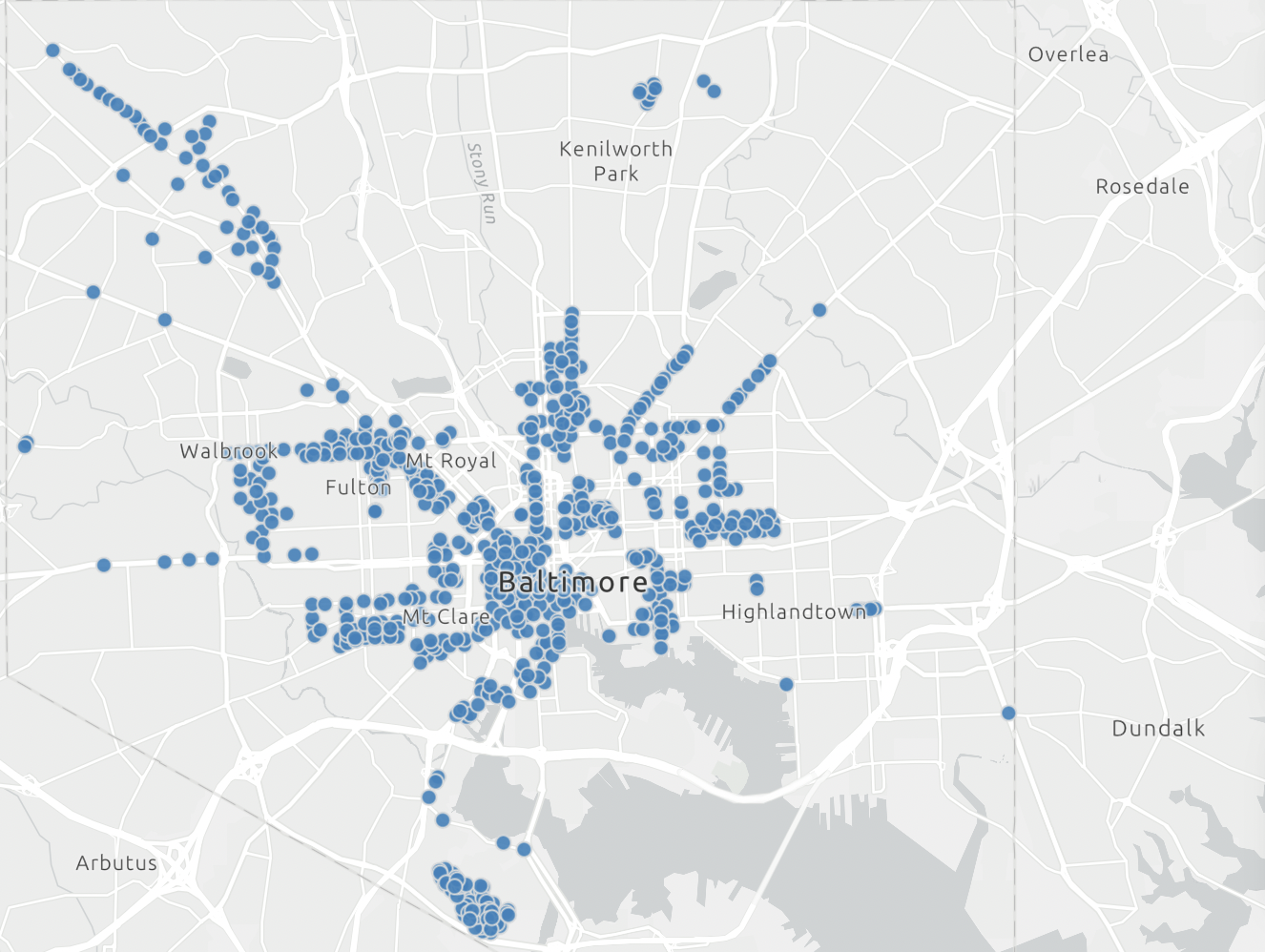
Cleveland still lacks policies aimed at balancing transparency, privacy, civil rights, and community safety—policies that exist in other large metropolitan areas. Camera locations in places like Baltimore and Oakland, California, are disclosed routinely and citizen panels increasingly vet how police use surveillance technology.

The absence of an open dialogue about how that technology will be used, what information is being collected and retained, and how it would be monitored for misuse seems inconsistent with the spirit of agreements between Cleveland and the U.S. Department of Justice, according to a report released in May by the city’s Community Police Commission. The commission, which was created to increase oversight and engage residents as part of a federal consent decree, pointed to a lack of vetted policies describing how the tools could be used constitutionally.

“It is surprising that with this administration we aren’t seeing some greater push for transparency on this stuff,” said Brian Ray, who directs the Center for Cybersecurity and Privacy Protection at Cleveland-Marshall College of Law. “I would have thought this administration would be a little different.”

Ray, who served as an advisor for the community police commission report, said it’s critical that residents know where cameras are and what law enforcement is using them for—at least to track potential discrimination in how they are used by police.

The issue of transparency was also raised recently by Cleveland’s consent decree monitoring team. A new report notes the department had yet to provide a draft of a policy on how it would release records, data and information to the public. The monitoring team called such policies “an important part of police legitimacy and demonstrations of transparency for the community.”

Though Bibb campaigned heavily on both transparency and police accountability, he has yet to say how he’ll balance the two.

Bibb and police brass announced in May that the city would expand its reliance on police surveillance technology by using a $355,400 state grant to buy two drones, 100 license plate reader cameras and five portable surveillance cameras. The concerns about transparency, the lack of policies and privacy issues were not addressed.

Council members, including those who enthusiastically support the use of cameras to deter crime or apprehend suspects, have questioned city officials about camera locations and surveillance capabilities.

Council member Joe Jones publicly pressed for information on the use of facial recognition technology during an April committee meeting.

The cameras can be programmed to recognize things—man, woman, dog, car, truck—and to match faces against existing databases, Froilan Roy C. Fernando, the city’s chief innovation and technology officer, explained during that committee meeting.

“And are we deploying the facial recognition piece?” Jones asked.

Howard cut in: “Councilman, what I would like is, if possible, if we could speak on the capability of our camera system privately.”

The city has also denied public records requests for camera locations. Last year, Cleveland Documenters, a community-based journalism group, requested the locations of more than 1,200 cameras that were placed around the city as part of the “Safe Smart CLE” initiative. 

The city refused and said the locations were exempt from public records law as “specific confidential investigatory techniques or procedures or specific investigatory work product.”

Officials did release a breakdown of the number of cameras placed in each ward and have said many of the cameras are placed near recreation centers and main corridors with existing infrastructure to support the cameras.

Officials told council members that neighborhoods with higher instances of crime often have fewer cameras. That’s because the cost of camera installation in neighborhoods that lack fiber-optic cable or advanced wireless networks can cost 10 times as much because the infrastructure needs to be built.

Council member Charles Slife, who sits on the Public Safety Committee, said Howard’s reasons for keeping the cameras secret make no sense.

“I don’t get it,” Slife said. “For me, the responses have defied logic.”

Polensek said residents he spoke with are overwhelmingly in favor of using surveillance cameras and want more in areas where crime is higher, businesses are targeted or illegal dumping is prevalent. He said he’s heard no fears about privacy issues or rights violations, but does believe information on how the city uses the cameras should be public.

City Council President Blaine Griffin, who for more than a decade responded to violent crimes while directing the city’s community relations board, said he understands the trepidation police have about revealing the locations of the cameras.

In Griffin’s view, the cameras are more investigatory tools, like wiretaps used to monitor drug dealing or devices to track homicide suspects, and less to prevent or deter crime.

“The challenge is making sure that you have transparency but also not tipping off the people you have surveillance on,” Griffin said.

The city, however, should share the types of cameras it purchases and what technologies it uses, Griffin said, because some—like license plate readers—can be misused or weaponized.

Other cities are more transparent

City officials’ stance on surveillance technologies hasn’t been tested legally.

“It’s common. I doubt it’s legal,” said Brian Hofer, chair and executive director of Secure Justice, an Oakland, CA nonprofit that fights what the organization views as abuses of power and overreach by governments and corporations, particularly when it comes to surveillance technology.

Hofer, who chairs Oakland’s Privacy Advisory Commission, has worked with more than 20 cities to vet contracts, create policies or legislation, or form commissions to oversee the use of surveillance technology by law enforcement.

The work isn’t about banning the use of all surveillance technologies, he said, but about residents understanding how they work and having a say in how they are used.

In Oakland, and other jurisdictions where Hofer has helped create technology-vetting frameworks, residents will often be okay with controversial or powerful technology used in limited situations, such as solving a violent crime. But they won’t ever want that same technology to be used to investigate a petty theft, he said.

If residents don’t know the specifications or where these things are being located, he said, it’s impossible to really make that informed decision of what meets community norms or standards.

Hofer has encountered pushback from police, who say that being too transparent could allow people to disable or evade the technology.

“Do you really think that the smash-and-grab guy is watching city council agendas and downloading your documents?” he said. “It’s just not happening.”

Cities such as Baltimore, Pittsburgh, and Washington, D.C., use camera networks and are routinely more transparent about locations or policies.

For years, Baltimore has maintained a network of hundreds of closed-circuit security cameras. Anyone with a smartphone or computer can search a city website to find the location of each of its hundreds of cameras.

Washington, D.C.’s Metropolitan Police Department began posting closed-circuit television cameras in neighborhood locations in 2006. Each camera location is listed on the police department’s website.

In 2021, the Pittsburgh Bureau of Police updated its nine-page policy for the “Public Safety Camera Program.” The city originally created the policy, accessible online, in 2016.

Pittsburgh, like Cleveland, does not disclose camera locations.

Pittsburgh does, however, have a city law that requires some transparency—each camera is paired with a street level sign telling residents a camera is in use.

The Los Angeles Police Department has built in layers of transparency and oversight for how the police department uses and shares information about cameras and other surveillance technologies. That’s partly due to its consent decree, which helped transform the LAPD from a militaristic agency to one that is focused on community policing, Los Angeles Police Commissioner Steve Soboroff told The Marshall Project.

Critics who are concerned about privacy abuses don’t like some policies, he acknowledged, but the policies are available for public review.

On Aug. 30, the Los Angeles Police Commission approved a new contract for up to $3 million to upgrade its existing network of 214 surveillance cameras posted across the city.

During a presentation, Office of Constitutional Policing & Policy Cmdr. Steve Lurie told the commission that 104 cameras are mounted at intersections and another 110 are mounted on city buildings.

No facial-recognition software is used with the camera system, Lurie said. During the public meeting, he also presented a geographic breakdown that showed the street locations among police districts. Lurie told The Marshall Project in some cases, locations are not disclosed for investigative reasons.

Los Angeles police Chief Michel Moore told the commission any new installation location is subject to public review by the Los Angeles Police Commission, which recently adopted new rules for how the city can use an array of available crime fighting technologies.

Under its new policy, the LAPD must submit a detailed proposal to the commission before deploying a particular technology, spelling out whether any data will be collected on people and for how long it will be kept, any infringements on people’s privacy and civil rights, and what safeguards are in place to guard against misuse, the Los Angeles Times reported.

LAPD is also required to report annually to the commission about its compliance to the policy.

In Cleveland, the Community Police Commission’s report recommended the city move toward a similar vetting strategy and public disclosure of a wide range of surveillance technologies, which include software or electronic devices and data systems designed to collect or retain information on people.

“How can you gain the trust of any community for anything or other law enforcement agencies, frankly, with decades-old practices of keeping everything shielded?” Soboroff said. “The idea of going opposite of the best practices in a business that is built on perception, trust and transparency is wrong.”

Cleveland Police Hiring Practices Are ‘Alarming’ and ‘Disturbing,’ Feds Say

By Mark Puente

This article was published in partnership with  The Marshall Project – Cleveland, a nonprofit news team focused on the Greater Cleveland area’s criminal justice system. Sign up for their newsletter.

A new report, from a federal monitor overseeing police reforms, is calling several Cleveland Division of Police practices “disturbing” and “alarming.” Among other findings, Cleveland hires officers who couldn’t pass background checks with other police forces.

The issues in the report mirror problems that surfaced in 2014 after an officer shot 12-year-old Tamir Rice. The department never investigated why that officer left a suburban force after a few months, Ideastream reported in 2014. A year later, the department was placed under a federal consent decree.

Lead monitor Hassan Aden wrote in the 75-page, semiannual report that the department still lacks in key foundational areas such as accountability, community engagement and building trust. He added that it still takes too long to investigate complaints against officers. The report is expected to be presented to senior U.S. District Judge Solomon Oliver Jr., who oversees the consent decree.

The new report shows the police department still must make changes that hold officers accountable when misconduct allegations surface.

“There are significant and critical areas of the Consent Decree that remain in noncompliance,” Aden wrote.

The consent decree agreed upon between the police department and the Department of Justice in 2015 did not assign guilt or liability. Instead, it created a blueprint to repair community relationships and overhaul how officers frequently used excessive force on residents.

The Marshall Project recently detailed how the city spent more than $60 million on reforms since it entered the consent decree in 2015. Residents and elected leaders questioned whether the money has improved the department’s relationship with the public.

Department practices that gained national attention years ago still linger.

In 2017, the city fired Officer Timothy Loehmann, who fatally shot Tamir Rice in 2014, for lying on his application about being unfit to serve. The officer did not disclose why he left the Independence Police Department, according to a Cleveland.com story.

The new report blasted the city for lacking “coordination and direction” when it comes to recruiting and hiring new officers. Monitors examined background reviews of new hires and said the “reviews could have been better” and found many cases to be “cursory.”

The department’s personnel hiring committee seemed to make hiring decisions “irrespective of the background investigations,” the report stated, calling it “disturbing.”

Monitors also found that veteran officers hired from other agencies should not have been hired because they had “significant background issues.”

“Most confounding in the reviews was the decision to extend an offer of employment to an individual when 12 of 13 members of the committee voted no upon considering that candidate,” Aden wrote in the report.

For years, residents, activists and some elected officials criticized the department for not moving fast to investigate misconduct allegations or conduct thorough investigations.

Here are areas, according to the report, where the department fails in internal investigations:

  • Conducting “objective, comprehensive and timely investigations of all internal allegations” or completing the investigations within 30 days from the date it learns of the alleged misconduct

  • Forwarding investigations to an officer’s supervisor or other review boards and committees within the department

  • During a review of eight internal investigations, monitors “identified substantive issues of concern in three” cases such as using leading questions and the quality of the findings

  • Monitors classified two use-of-force cases investigated by the Force Investigations Team as “poor” and not in compliance with the consent decree

When it comes to harassment or bias complaints, the police force uses the city’s human resources department to investigate those allegations.

For example, monitors had been tracking two cases brought to their attention by the Black Shield Police Association, an association of Black Cleveland police officers. In one, a complaint was made to the former chief in January 2021. Nine months later, the department told monitors the case was near completion, the report said.

Monitors learned the department did not start the investigation until July 2022, 18 months after allegations surfaced.

“That is a significant delay that will not only impact the quality of the investigation, it also does not engender any reasonable belief on the part of the monitoring team that the city is capable of fairly adjudicating these complaints,” Aden wrote.

The consent decree required the city to beef up its staff in the Office of Professional Standards, a civilian office that investigates complaints.

Monitors noted in December 2019 and in September 2020 that the office had a backlog of cases and that cases older than a year had doubled. Investigators also did not have a “sustainable workload.”

As of May 2022, the office has not sent a biweekly report because a staffer resigned, the report said. While the caseload per investigator has decreased slightly, the number of investigations older than one year “is still unacceptably high,” the report said.

Another goal of a consent decree is to require police departments to share more information with the public, such as crime statistics or new policies.

Issues remain for the department’s website. Monitors said they “remain concerned about outdated information” and that it’s hard for people to find information if they are not informed users, the report said.

“Someone in the division must take responsibility for the accuracy of the website,” Aden wrote in the report. “It has become easier to find important documents on the website, but they remain organized in a way that suits the division and not the public.”

A consent decree’s oversight ends only when a federal judge says it does.

Aden’s new report is the first published under Mayor Justin Bibb, who took office in January. Bibb recently told The Marshall Project that he would like to end the federal oversight by the end of 2025.

The report said Bibb “has been extremely thoughtful and deliberate” about meeting with monitors and listening to ideas to improve the department. Aden noted that Bibb is building a city team whose focus is to keep the city’s compliance efforts on track.

The new report does note some progress: The department has created a community police commission and developed a system for reporting use of force and crisis intervention.

The Marshall Project Visual Cards

What Do You Want to Know About Criminal Courts in Cleveland?

Anyone with access to the internet can look up felony court cases in Cuyahoga County one by one. But understanding how case outcomes vary by judge or by a defendant’s race is impossible without being able to examine all the cases together. The court doesn’t release that data publicly, and The Marshall Project and The Cleveland Observer believe that transparency is essential to understanding flaws in the criminal justice system, including the disproportionate incarceration of Black Clevelanders.

The Marshall Project is scraping records from the court’s public docket and is committed to answering questions directly from community members about the court system.

Find the answers to questions your friends and neighbors submitted using  this new tool. Submit your questions below.

Not sure what to ask? Here’s an example of a question we’ve answered.

Find the answers to questions your friends and neighbors submitted using  this new tool.