CityVoiceCLE Local updates. Clear action.

Community Speaks Against Building New County Jail

By Doug Breehl-Pitorak (he/him)
The Public Meetings Report is produced by Signal Cleveland and Cleveland Documenters.

Cleveland Public Meetings Report – The week of Oct. 9
Residents ask for community investment, not another jail
Byline: Dakotah Kennedy and Documenter Aaron Skubby
LaTonya Goldsby, president and co-founder of Black Lives Matter Cleveland, speaks during the Cuyahoga County Council meeting on Oct. 10. Credit: Cuyahoga County YouTube.
Challenging the status quo: During public comment, several residents spoke out against the recent purchase of land in Garfield Heights for a new jail. “This proposed jail is a tax on our future and evidence that our county leaders’ bold vision for our future is more mass incarceration,” said LaTonya Goldsby, president and co-founder of Black Lives Matter Cleveland.

Goldsby also called attention to the people who recently died in custody at the Cuyahoga County Jail. On Oct. 6, a man died following a medical emergency. He is the third incarcerated person in three months to die at the jail.

$10 million for housing help: Council approved funds for emergency rental assistance to help Cuyahoga County residents who are at least 55 years old and meet income requirements. The funding will support Empowering and Strengthening Ohio’s People (ESOP)’s efforts to provide financial counseling and assistance to residents.

ESOP is a nonprofit housing and counseling agency that is part of the Benjamin Rose Institute on Aging. ESOP hosts free online classes to help residents navigate buying and selling property. Its classes also boost financial wellness and offer advice for aging homeowners.

MomsFirst participation on the decline
Byline: Anastazia Vanisko and Documenters Janenell Smith and Alicia Moreland

Oct. 9 – Health Human Services and the Arts Committee, Cleveland City Council
Commissioner of Health Equity and Social Justice Lita Wills shares updates about the MomsFirst program. (Credit: Cleveland City Council YouTube)
MomsFirst: Cleveland’s MomsFirst program is down more than 150 participants compared to the past two years. The program provides free support to parents until babies are 18 months old and pairs participants with a community health worker.
Council Member Kris Harsh asked about the reason for the drop. Lita Wills, Cleveland’s commissioner of Health Equity and Social Justice, attributed it to staffing. She said they had to shrink the staff size after they “right-sized” community health worker pay, increasing the hourly wage to be more comparable to what other organizations pay. Before these changes, Wills said there were “several positions with multiple vacancies.”
Despite the drop in participants, MomsFirst increased the number of visits where they provided a service to mothers, according to Wills’ presentation. Harsh said it appeared that participants were receiving more intensive care, which Wills affirmed.
Opioid settlement dollars: “Cleveland will receive around $360,000 from an opioid settlement with drug manufacturers and distributors”, Wills said. She said the money will be used to support addiction recovery. The services include individual and group counseling, rides to medical appointments, and training on how to use naloxone, a medication used to reverse opiate overdoses.
Brenda Glass Trauma Center set to get $500,000 grant
Byline: Doug Breehl-Pitorak and Cleveland Documenters Marcy Clark, Tim Zelina, and Chanel Wiley
Oct. 9 – Cleveland City Council

Council President Blaine Griffin responds to a public comment at the Oct. 9 City Council meeting. (Credit: Cleveland City Council YouTube)
Support for trauma care: Cleveland City Council passed 10+ pieces of legislation, including a grant of up to $500,000 for the Brenda Glass Multipurpose Trauma Center. The money is to assist with repairs and upgrades to the center, which offers trauma recovery services for survivors of violence.

Affordable senior housing: Council OK’d a grant of up to $1 million for the Northwest Neighborhoods Community Development Corp. The money, which comes from Cleveland’s pot of American Rescue Plan Act dollars, is to help construct 51 apartments for seniors in Detroit-Shoreway. The units would be for people aged 55 and older. Eight units are reserved for residents whose annual income is $15,960 or less.

‘Don’t know what else to do’: Isaiah Dixon made a public comment. He said he was experiencing homelessness and asked the council for help. “I sleep on the ground pretty much every day. I dodge the rain as much as I can,” Dixon said. “But it’s getting cold, and I don’t know what else to do.”

Council President Blaine Griffin asked audience members to connect with Dixon to see what help they could offer.
Walk-up public comments at CMSD board meetings may end 
Byline: Doug Breehl-Pitorak and Cleveland Documenters Tina Scott and Marvetta Rutherford
Oct. 10 – Board meeting, Cleveland Metropolitan School District

District CEO Warren Morgan II and Board Chair Sara Elaqad at the Oct. 10 board meeting. (Credit: Cleveland Metropolitan School District YouTube)
12 o’clock rock: Residents may no longer have the option to just show up to speak at Cleveland school board meetings. They’ll have to sign up ahead of time, if board members approve new rules at their Oct. 24 meeting. Speakers would have to complete an online form by noon on the day of board business meetings, which typically start at 6:30 p.m. “They may also call the board’s office at 216-838-0030 to register”, Board Chair Sara Elaqad said. The speaking time limits would remain the same: 40 minutes total for public comments and three minutes for each speaker.

On the agenda: The board discussed 10 other resolutions set for a vote later this month. One would let the district participate in a program to get its slice of property tax revenues from Cuyahoga County earlier than scheduled in 2024. It would receive two advances of about $20 million each, according to District CEO Warren Morgan II. Another resolution would put up to $1.6 million toward digitizing student records.

Fuzzy demographics: During a presentation about Riverside PreK-8 school, Principal Jessica Gamble said the school’s official racial and ethnic demographics, which show 52% of students identify as Caucasian, are a little skewed. Some races and ethnicities aren’t options on the demographic form, Gamble said, adding that many students who may otherwise identify as Arabic or Middle Eastern select Caucasian. Of the school’s 481 students, about 15% speak Arabic, according to Gamble. The school is in Ward 17 on the West Side.

Seat at the table: There is an open seat on the Board of Education. “Lisa Thomas resigned from the board after 12 years”, Elaqad announced. The term ends June 30, 2025. Check out the application.

Documenters: Monthly Highlights

Public Meetings Report for Community Partners (OCT. 2023)

Public commenters support Cleveland’s Palestinian community; Cleveland police give staffing update

Cleveland Public Meetings Report – The week of Oct. 16

The Public Meetings Report is produced by Signal Cleveland and Cleveland Documenters. Here’s what happened last week in local public government meetings covered by Cleveland Documenters.

Here’s what happened last week in local public government meetings covered by Cleveland Documenters.

Public commenters support Cleveland’s Palestinian community

Byline: Anastazia Vanisko and Cleveland Documenters Karima McCree-Wilson and Christina Easter
Omar Kurdi makes a public comment at Cleveland City Council. (Credit: Cleveland City Council YouTube)
Public pushback: Six residents of Greater Cleveland voiced their disapproval of Mayor Justin Bibb’s Oct. 7 statement in support of Israel, saying it is one-sided. Faten Odeh, the interim executive director of the Cleveland and Northern Ohio chapter of the Council on American-Islamic Relations, said that Bibb’s statement ignored decades of Israel’s violence.

‘Dismissed and diminished’: Summer Husein said Bibb’s tweet made the more than 25,000 Palestinian people living in Greater Cleveland feel less safe. “With just one tweet, you dismissed and diminished the oppression that Palestinians have had to endure for over 75 years,” she said.

Omar Kurdi said that, during a TV interview next to City Hall the week prior, someone took a picture of him and posted it online, calling him a terrorist. “I want to see real commitment from the city to protect us, to humanize us and our people, and to stand up for all civilian lives,” he said.
No legislation passed: Only 11 members of City Council were present for the Monday meeting. An official told Council President Blaine Griffin that, due to the excused absences, they would not be able to pass any legislation that evening. Council Members Joe Jones, Brian Kazy, Rebecca Maurer, Jenny Spencer, Jasmin Santana and Richard Starr were absent.
Left wondering: Documenter Karima McCree-Wilson asked, “What, if anything, has Bibb done to better understand and acknowledge the perspective of local Palestinians?”
 

Makeover planned for downtown Cleveland’s Erieview Tower

Byline: Dakotah Kennedy and Cleveland Documenters Timothy Zelina and Marcy Clark
Members of the Development, Planning & Sustainability Committee meet with Building and Housing staff on Oct. 17. (Credit: Cleveland City Council YouTube)
Vacant no more: City Council’s Development, Planning and Sustainability committee approved the next step in a project to breathe new life into Erieview Tower in downtown Cleveland. The project will cost $217 million and include improvements to approximately 300,000 square feet of office space.
James Kassouf, the developer whose family owns 25 acres of downtown real estate, is requesting a tax increment financing plan (TIF) to help fund the project. Approval of the TIF will require a separate piece of legislation.
The estimated value of the TIF is $1.6 million, according to Robin Brown, a project manager for the City of Cleveland.
“We have an opportunity to largely convert this building from 80% vacant into a hotel, residential, and office, which is consistent with reimagining the downtown plan,” said Brown.
Previously used as office space, the new plan includes luxury-branded hotel rooms, apartments, a spa and a revitalized Galleria. Construction is set to start in early 2024, according to the project team.
Staffing troubles: Ward 10 Council Member Anthony Hairston asked why the headcount remains down at the Department of Building and Housing despite budgeting for new positions.
Sally Martin O’Toole, department director, said that it’s been a “tremendous challenge” to attract and retain staff because of low pay. If Residents First legislation passes, the department can hire more inspectors, according to O’Toole.
Settling for citations: Officials expressed concerns about the lack of accountability for business owners failing to take care of their buildings.
Right now, the city can issue citations but not fines, according to Chief Building Officer Tom Vanover. If businesses ignore citations, court proceedings begin and judges can issue fines. But out-of-town landlords often don’t show up to court, O’Toole added. Residents First would also let the city issue civil fines upfront, Vanover said.
Cleveland police provide staffing, budget updates
Byline: Anastazia Vanisko and Documenter Lauren Hakim
Oct. 11 – Safety Committee, Cleveland City Council

Members of the Department of Public Safety – led by Director Karrie Howard (right) – at the Oct. 11 Safety Committee meeting. (Credit: Cleveland City Council YouTube)

Positions to fill: Cleveland City Council is getting a head start on budget season by conducting operational reviews of city departments. The Safety Committee’s Oct. 11 review of the Cleveland Division of Police confirmed that the city has still not filled all the positions that were budgeted for.
Although fewer positions are filled now than at the end of 2022, fewer officers have left the force, officials said. In 2022, 168 officers left, as opposed to 133 so far in 2023.
Overtime: There was another budget upset revealed during the committee’s review: According to Daniel Fay, deputy chief of administrative operations, the city has spent $20 million on overtime for officers. Only $13 million was budgeted.

————————————————————————————————-
Community members speak against building new county jail; City Council OKs up to $500,000 for upgrades to trauma center

Cleveland Public Meetings Report – The week of Oct. 9

The Public Meetings Report is produced by Signal Cleveland and Cleveland Documenters. Here’s what happened last week in local public government meetings covered by Cleveland Documenters.

Residents ask for community investment, not another jail
Byline: Dakotah Kennedy and Documenter Aaron Skubby

Oct. 10 – Cuyahoga County Council

Caption: LaTonya Goldsby, president and co-founder of Black Lives Matter Cleveland, speaks during the Cuyahoga County Council meeting on Oct. 10. Credit: Cuyahoga County YouTube.


Challenging the status quo: 
During public comment, several residents spoke out against the recent purchase of land in Garfield Heights for a new jail. “This proposed jail is a tax on our future and evidence that our county leaders’ bold vision for our future is more mass incarceration,” said LaTonya Goldsby, president and co-founder of Black Lives Matter Cleveland.

Goldsby also called attention to the people who recently died in custody at the Cuyahoga County Jail. On Oct. 6, a man died following a medical emergency. He is the third incarcerated person in three months to die at the jail.

$10 million for housing help: Council approved funds for emergency rental assistance to help Cuyahoga County residents who are at least 55 years old and meet income requirements. The funding will support Empowering and Strengthening Ohio’s People (ESOP)’s efforts to provide financial counseling and assistance to residents.

ESOP is a nonprofit housing and counseling agency that is part of the Benjamin Rose Institute on Aging. ESOP hosts free online classes to help residents navigate buying and selling property. Its classes also boost financial wellness and offer advice for aging homeowners.MomsFirst participation on the decline

Byline: Anastazia Vanisko and Documenters Janenell Smith and Alicia Moreland
Oct. 9 – Health Human Services and the Arts Committee, Cleveland City Council

Commissioner of Health Equity and Social Justice Lita Wills shares updates about the MomsFirst program. (Credit: Cleveland City Council YouTube)

MomsFirst: Cleveland’s MomsFirst program is down more than 150 participants compared to the past two years. The program provides free support to parents until babies are 18 months old and pairs participants with a community health worker.
Council Member Kris Harsh asked about the reason for the drop. Lita Wills, Cleveland’s commissioner of Health Equity and Social Justice, attributed it to staffing. She said they had to shrink the staff size after they “right-sized” community health worker pay, increasing the hourly wage to be more comparable to what other organizations pay. Prior to these changes, Wills said there were “a number of positions with multiple vacancies.”
Despite the drop in participants, MomsFirst increased the number of visits where they provided a service to mothers, according to Wills’ presentation. Harsh said it appeared that participants were receiving more intensive care, which Wills affirmed.
Opioid settlement dollars: Cleveland will receive around $360,000 from an opioid settlement with drug manufacturers and distributors, Wills said. She said the money will be used to support addiction recovery. The services include individual and group counseling, rides to medical appointments, and training on how to use naloxone, a medication used to reverse opiate overdoses.
Brenda Glass Trauma Center set to get $500,000 grant
Byline: Doug Breehl-Pitorak and Cleveland Documenters Marcy Clark, Tim Zelina and Chanel Wiley
Oct. 9 – Cleveland City Council

Council President Blaine Griffin responds to a public comment at the Oct. 9 City Council meeting. (Credit: Cleveland City Council YouTube)

Support for trauma care: Cleveland City Council passed 10+ pieces of legislation, including a grant of up to $500,000 for the Brenda Glass Multipurpose Trauma Center. The money is to assist with repairs and upgrades to the center, which offers trauma recovery services for survivors of violence.

Affordable senior housing: Council OK’d a grant of up to $1 million for the Northwest Neighborhoods Community Development Corp. The money — which comes from Cleveland’s pot of American Rescue Plan Act dollars — is to help construct 51 apartments for seniors in Detroit-Shoreway. The units would be for people age 55 and older. Eight units are reserved for residents whose annual income is $15,960 or less.

‘Don’t know what else to do:’ Isaiah Dixon made a public comment. He said he is experiencing homelessness and asked council for help. “I sleep on the ground pretty much every day. I dodge the rain as much as I can,” Dixon said. “But it’s getting cold, and I don’t know what else to do.”

Council President Blaine Griffin asked audience members to connect with Dixon to see what help they could offer.
Walk-up public comments at CMSD board meetings may end 
Byline: Doug Breehl-Pitorak and Cleveland Documenters Tina Scott and Marvetta Rutherford
Oct. 10 – Board meeting, Cleveland Metropolitan School District
District CEO Warren Morgan II and Board Chair Sara Elaqad at the Oct. 10 board meeting. (Credit: Cleveland Metropolitan School District YouTube)

12 o’clock rock: Residents may no longer have the option to just show up to speak at Cleveland school board meetings. They’ll have to sign up ahead of time — if board members approve new rules at their Oct. 24 meeting. Speakers would have to complete an online form by 12 p.m. on the day of board business meetings, which typically start at 6:30 p.m. They may also call the board’s office at 216-838-0030 to register, Board Chair Sara Elaqad said. The speaking time limits would remain the same: 40 minutes total for public comments and three minutes for each speaker.

On the agenda: The board discussed 10 other resolutions set for a vote later this month. One would let the district participate in a program to get its slice of property tax revenues from Cuyahoga County earlier than scheduled in 2024. It would receive two advances of about $20 million each, according to District CEO Warren Morgan II. Another resolution would put up to $1.6 million toward digitizing student records.

Fuzzy demographics: During a presentation about Riverside PreK-8 school, Principal Jessica Gamble said the school’s official racial and ethnic demographics — which show 52% of students identify as Caucasian — are a little skewed. Some races and ethnicities aren’t options on the demographic form, Gamble said, adding that many students who may otherwise identify as Arabic or Middle Eastern select Caucasian. Of the school’s 481 students, about 15% speak Arabic, according to Gamble. The school is in Ward 17 on the West Side.

Seat at the table: There is an open seat on the Board of Education. Lisa Thomas resigned from the board after 12 years, Elaqad announced. The term ends June 30, 2025. Check out the application.

————————————————————————————————-

Cleveland City Council OKs $3.5 million for police helicopters; Diversion center not working as planned, county official says

Cleveland Public Meetings Report – The week of Oct. 3

The Public Meetings Report is produced by Signal Cleveland and Cleveland Documenters. Here’s what happened last week in local public government meetings covered by Cleveland Documenters.

$3.5 million approved for Cleveland police helicopters

By Dakotah Kennedy and Documenters Dean Jackson, Lakeisha Smith and Alicia Moreland
Oct. 2 – Cleveland City Council
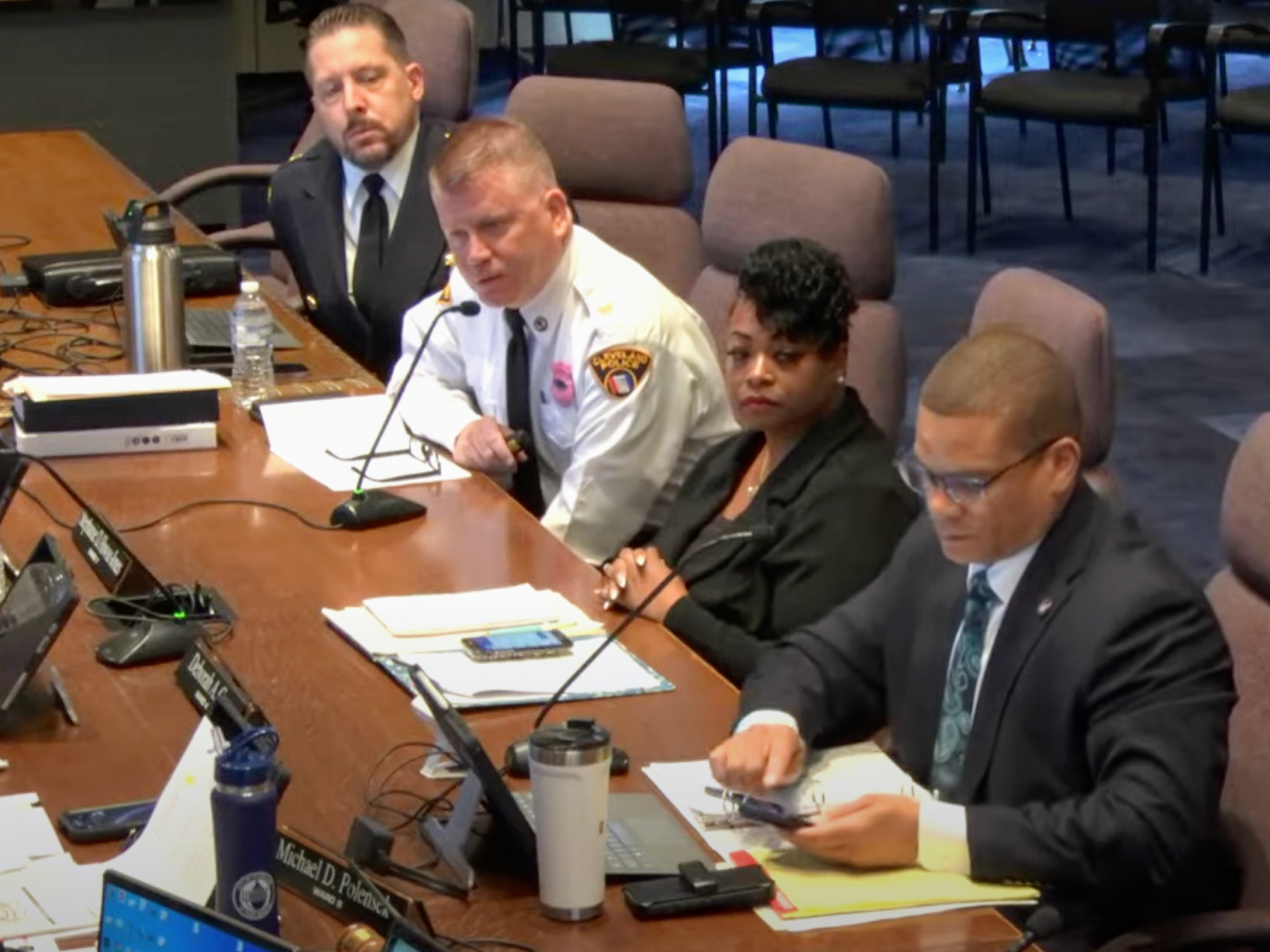
Caption: Ward 8 Council Member Michael Polensek speaking about crime in Cleveland during a City Council meeting. Credit: Cleveland City Council YouTube.
Putting the cop in helicopter: Cleveland City Council approved $3.5 million to make repairs and upgrades to two Cleveland police helicopters. Council President Blaine Griffin and Council Member Michael Polensek sponsored the legislation. Ward 17 Council Member Charles Slife was the only council member to vote against the legislation.
Balancing rights: City Council is considering changes to its public comment rules after antisemetic and anti-LGBTQ statements at a recent meeting. Ward 15 Council Member Jenny Spencer suggested taking a look at the rules to prevent future incidents. Spencer also said she hoped for clarification on the exact circumstances when the council president could “gavel down” a speaker.
Commenters say: Several people spoke up about previous comments targeting the Jewish and LGBTQ+ communities. “Our collective strength, including our allies– our Jewish brothers and sisters and siblings– should not be underestimated,” said Phyllis Harris, director of the LGBT Community Center of Greater Cleveland.

Here to stay: Council members said that they do not want to end public comment. Public comment has been a practice in city council since October 2021, following a 90-year absence. Council President Griffin said he met with attorneys to find  the best path forward to protect free speech rights while also protecting communities from identity-based attacks.Not enough police use Cuyahoga County Diversion Center, official says

By Doug Breehl-Pitorak and Cleveland Documenter Barbara Phipps
Oct. 6 – Public Safety & Justice Affairs Committee, Cuyahoga County Council

Cuyahoga County Council Member Michael Gallagher asks about the Diversion Center. (Credit: Cuyahoga County Council YouTube)

Diversion needed: The Cuyahoga County Diversion Center is not being used as intended, County Council Member Michael Gallagher said. He took issue with how seldom law enforcement agencies refer people there. The center is at a building owned by behavioral health group Oriana House on E. 55th Street. Opened in May 2021, the center’s purpose was to keep people experiencing mental health issues out of  the criminal justice system and reduce the county jail population. Instead, it functions primarily as a mental health services center available to anyone, Gallagher said, adding that it needs buy-in from police departments.

Making calls: Brandy Carney, the county’s chief of Public Safety & Justice, acknowledged that law enforcement agencies have been slow to embrace the center. Carney, who also sits on a board that advises on the center, shared that 78% of all referral calls through July 2023 (2,827 total) came from community members, self-referral or other agencies. Twenty-two percent came from police. It is a culture shift that will take time, Carney said.

‘Pin’s going to get pulled’: In August, the Cuyahoga County Sheriff’s Office joined a state- and federally-supported initiative to help Cleveland address crime. Details of that effort — a downtown Cleveland safety patrol consisting of eight deputy sheriffs, one sergeant, and two canine units — were well-received at a September Cleveland City Council meeting. But at least one county official — Gallagher — isn’t as thrilled. “We’re eight weeks deep into this and doing Cleveland’s job for them with other partners,” he said to Sheriff Harold Pretel in this meeting. “We’re at a point where…the pin’s going to get pulled.”Helping a city:

Pretel came to the county this year after spending nearly 30 years with Cleveland’s police department. Pretel gave a sweeping presentation of the department’s operations, noting high staffing levels. The downtown initiative is about the county supporting a municipality, as it would if Rocky River of Maple Heights asked for help, Pretel said. 

Public Meetings Report for Community Partners (SEPT. 2023)

Doug Breehl-Pitorak (he/him)
Public comment back at City Council; higher parking rates on horizon
Meeting coverage by Cleveland Documenters | Compiled by Signal Cleveland’s Doug Breehl-Pitorak and Anastazia Vanisko | Edited by Rachel Dissell and Mary Ellen Huesken

Here’s what happened last week in local public government meetings covered by Cleveland Documenters. Cleveland Public Meetings Report – The week of Sept. 18
Metered parking in Cleveland neighborhoods to cost between $1 and $5 per hour
Sept. 18 – Finance, Diversity, Equity and Inclusion Committee, Cleveland City Council
Covered by Documenters Carolyn Cooper (notes) and Christina Easter (live-tweet thread)
Commissioner of Parking Facilities Kim Johnson and Director of Public Works Frank Williams. (Credit: Image captured from Cleveland City Council YouTube by Documenter Christina Easter)
Parking prices going up: Cleveland residents and visitors will soon see pricier parking. The committee advanced legislation to raise maximum rates at some city-owned lots. That includes the Muni Lot, a popular spot for tailgating before Browns games.

City Council passed the legislation later that night (it held the proposal in August). One sticking point was the proposed pricing at parking meters, A range between $1 and $8 per hour. Some council members said that range may suit downtown but not Cleveland’s neighborhoods. In this meeting, the committee voted to cap the cost at $5 per hour for meters outside downtown.

What’s the chatter? Some residents have asked why they can’t send public chat messages on CityCouncil’s YouTube page, according to Council Member Brian Kazy. Va’Kedia Stiggers, council staff, said the council doesn’t allow comments on the livestreams of meetings “because of some of the comments that people were leaving.” Stiggers said people can post comments to TV 20’s Facebook pageCity Council’s Facebook page, and City Council’s X (Twitter) account.

Left wondering: The parking rates discussion and the exchange about online comments stuck with Documenter Carolyn Cooper. She asked, “Will residents with disabilities be offered certain spaces and discounted parking rates? Will the council eventually allow live questions and public comments–via social media or livestream–for elderly and disabled residents who cannot attend meetings in person?”

Court grant: The committee OK’d legislation for a $200,000 grant from the Cuyahoga County Alcohol, Drug Addiction and Mental Health Services Board. It is for the Cleveland Municipal Courts’ specialized dockets. They include the:

  • Veterans Docket (led by Judge Charles Patton Jr.)
  • Human Trafficking Docket (led by Judge Marilyn Cassidy)
  • Drug Court Docket (led by Judge Lauren Moore)
  • Mental Health Docket (led by Judge Suzan Sweeney)
Each docket receives $45,000 to $55,000 of the grant money, said Court Administrator Russell Brown III. The court has used the money for client services and treatment, Brown added.
A request for data: The committee approved an amendment proposed by Council Member Mike Polensek. It requires that the council receive a quarterly report on the demographics of people served by this grant, organized by the city ward.

Curious about the parking rates plans? Check out the 
city’s presentation. Interested in sending Cleveland City Council a public comment online? You can do that on its website.
Board delays decisions on East Side group homes
Covered by Documenters Tina Scott (notes) and Marvetta Rutherford (live-tweet thread)
The location of a proposed East Side group home. (Credit: Cleveland City Planning Commission YouTube)
Postponed decisions: After much back and forth between project representatives, community members, and one council member, the Board of Zoning Appeals delayed decisions on two East Side group homes.
Emergent Evolutions LLC proposed a group home for veterans in need of rehabilitation services on Martin Luther King Jr. Blvd. Cleveland City Council Member Deborah Gray said she was told the group home would be for children. The project representative attributed the confusion to a statement he made to Gray about the company also working in childcare. Gray said she would support the project if the community wanted it, as the representative had presented 28 signatures from residents in support.
Zoning Board Chair Alanna Faith suggested postponing the decision so the council member could clarify the purpose of the project and hold a community meeting on the subject. Gray agreed.
BJB Enterprise LLC also proposed a group home, this one for three women over 30 on East 93rd Street. Two neighbors came to the meeting to express concern about ongoing issues of property maintenance and crime that went unaddressed by previous property owners.
One of the neighbors said the street already had three or four group homes, although City Planning’s map only showed one. Chief City Planner Maurice Ruelens said any additional group homes are likely unregistered or are classified as rooming houses.

Ruelens also said he was concerned about operating a group home–which is a business—out of a row house with existing residential tenants. He suggested hosting a community meeting to gather more input from residents. Board members postponed their decision to Oct. 9th so that there would be time to confirm the number of group homes in the area and do a site visit to the property.

Taking it to court: Two Ward 1 residents, upset with the board’s decision regarding the property next to theirs, are appealing the decision to the Cuyahoga County  Court of Common Pleas. The two women had previously argued against the positioning of their neighbor’s proposed garage, but the board determined that their complaint was an aesthetic preference rather than a rights violation.

The five-member Board of Zoning Appeals has been down one member since June, and at least three yes votes are required for an appeal to be approved. If fewer than three board members are present, then the board can’t conduct business. Signal Cleveland Reporter Nick Castele has more on the impact these instances have on Cleveland residents.

Public comment back at City Council, as is call for flavored-tobacco ban
Covered by Documenters Hannah Morgan (notes) and Stésià Swain (live-tweet thread)
Thad Franklin, Cleveland resident and owner of Major League Barber Shop, makes a public comment. (Credit: Cleveland City Council YouTube)
Returns: Public comment returned for the first time since June 5, the beginning of City Council’s summer recess with the opportunity returned requests for the council to ban the sale of flavored tobacco in Cleveland. It has been a consistent theme among commenters since Mayor Justin Bibb’s administration proposed legislation in February.
Barber for the ban: This time, Cleveland resident and barber Thad Franklin said flavored tobacco products are marketed to youth, especially in Black neighborhoods. Franklin started a campaign called Victimizing All People Everywhere (VAPE). In October, some churches and barbershops are hosting No-Menthol Sunday activities, Franklin added.
Franklin, like others, urged the council to pass the ban. The council has not moved the proposal forward. Signal’s Nick Castele has the latest.
Sister up: Cleveland could soon become a sister city with towns in three African countries. Council introduced legislation that would allow Mayor Justin Bibb to enter sister-city agreements with Cape Town, South Africa, Kigali, Rwanda, and Tema, Ghana.
Casino money coming? Council OK’d six uses of its discretionary casino revenue money, which comes from taxes on statewide casino proceeds. Projects set to be supported by the money include:
  • The Puerto Rican Expo
  • A Ward 4 planning project
  • Calgary Park upgrades
This spring, Signal Cleveland spoke with intended recipients about delays in receiving casino money promised by the City Council. One group, Neighborhood Pets, received a check for $25,000 more than two years after it was approved.

Wondering how to sign up to make a public comment? Check out 
our guide.
Future Ink, Ohio Voice, and Delta Alpha Lambda Foundation are in line for funding
Sept. 18 – Community Development Committee, Cuyahoga County Council
Covered by Documenter Tucker Handley (notes)
Council Member Michael Gallagher talks about the lack of care for seniors in Cuyahoga County. (Credit: Cuyahoga County Council YouTube)
ARPA funding community: Committee members moved forward with legislation approving American Rescue Plan Act funding for three community organizations—Future Ink Graphics, Ohio Voice, and the Delta Alpha Lambda Foundation.
Future Ink Graphics, in partnership with the Cuyahoga County Board of Developmental Disabilities, would receive $20,000 to support both the Creative Residency Program for artists with disabilities and professional development training for emerging designers.
Ohio Voice is in line for $10,000 and the Delta Alpha Lambda Foundation for $20,000, both for repairs to their facilities. Pastor Evan Regis Bunch said that Ohio Voice is acting as the fiscal sponsor for Fifth Christian Disciples of Christ. The church will use the funding to make repairs to its kitchen so that they can continue to provide meals for children participating in its social action programs.
Lateef Saffore, chair of the Delta Lambda Foundation, said they will use the funding to repair the food pantry distribution site on East 116th Street.
The next step in the approval process is for the full County Council to hear the legislation.
Taking care of seniors: Council Member Michael Gallagher said that the county needs to do more to provide for aging seniors. He said, “There’s no reason whatsoever that a senior should go, in the latter years of their life, to worry about anything, and mostly in Cuyahoga County they worry about everything.”
His comments followed the county’s Director of Housing and Community Development Sarah Parks Jackson’s introduction of a resolution that would authorize $6.35 million in federal HOME and emergency rental assistance loans to organizations constructing and rehabilitating affordable housing units in Cleveland, Lakewood, and Cleveland Heights.
Some of the funding, including $1 million for the Benjamin Rose Institute on Aging and $450,000 for the Commonwealth Development Corp. of America, is for senior apartments.
The committee approved the legislation, and it will go to the full council for its next reading.
Left wondering: Documenter Tucker Handley asked, “Why do grant applications for $10,000 to $20,000 have detailed PowerPoint presentations, while $10 million disbursements are approved with little to no comment?”

The county provides thousands of dollars in ARPA funding to community organizations, including Comics at the Corner. 
Learn more about Dawn Arrington’s comics-based literacy program.
On Deck
Sept. 25 
  • 9:30 a.m. – Cleveland Board of Zoning Appeals (livestream)
  • 2 p.m. – Cleveland City Council Finance, Diversity, Equity, and Inclusion Committee (livestream)
  • 7 p.m. – Cleveland City Council (livestream)
Sept. 26
  • 9 a.m. – Civilian Police Review Board (livestream)
  • 9:30 a.m. – City Council Development, Planning, and Sustainability Committee (livestream)
  • 5 p.m. – Cuyahoga County Council (livestream)
Sept. 27
  • 10 a.m. – Cleveland City Council Safety Committee (livestream)
  • 3 p.m. – Cleveland Board of Control (livestream)
  • 6 p.m. – Cleveland Community Police Commission (livestream)
————————————————————————————————-
Cuyahoga County Council OKs up to $30,000 for Neighborhood Pets; election officials talk cybersecurity Meeting coverage by Cleveland Documenters | Compiled by Signal Cleveland’s Doug Breehl-Pitorak and Anastazia Vanisko | Edited by Rachel Dissell and Mary Ellen Huesken

Here’s what happened last week in local public government meetings covered by Cleveland Documenters. Cleveland Public Meetings Report – The week of Sept. 11 Cuyahoga County Council OKs up to $30,000 for Neighborhood Pets
Covered by Documenter Joanna Tomassoni (notes)

Cuyahoga County Council Member Sunny Simon speaks at the Sept. 12 meeting. (Credit: Cuyahoga County Council YouTube)

Pet care for seniors: Neighborhood Pets got a financial boost. Cuyahoga County Council approved a grant of up to $30,000 of federal stimulus money to the nonprofit, which offers free and low-cost supplies to pet owners. The grant will support pet care for homebound seniors.
“The Slavic Village nonprofit also offers wraparound services for pet owners,” said Council Member Sunny Simon. “The pets are the entryway, and sometimes you need different touchpoints for [people] to allow you in to give them help,” Simon said.

One wait for money begins, another ends: This spring, Signal Cleveland spoke with Neighborhood Pets about the nonprofit’s yearslong wait for $25,000 promised from Cleveland City Council’s slice of state casino revenues. At that time, Neighborhood Pets was still waiting for the money, which council approved in December 2021. The organization received a check from the city for the full amount in early September, Executive Director Becca Britton told Signal Cleveland in an email. “It only took years and relentless badgering to make this happen,” Britton wrote.

Construction concerns: Loh, a community activist, spoke about renovations at the YWCA Norma Herr Women’s Center. It is a shelter for women experiencing homelessness. The dust and other construction complications have made it challenging for residents and workers, Loh said. Documenters Walter Topp and Gennifer Harding-Gosnell summarized renovation plans as presented to the Cleveland Landmarks Commission in August of 2022.

Budget shuffle: Council also moved some money budgeted for 2022-2023 to different departments, but first, it voted to remove these proposals from the legislation (found on pg. 86 of the agenda packet) and refer them to committees for further review:

  • About $574,000 for the County Executive office for personnel and operating expenses
  • About $2.16 million for constructing foster care housing at the Metzenbaum Center
  • $2 million for the Freshwater Institute project
Curious about Cleveland City Council’s casino revenue money? Take a deep dive with civic-minded folks at the Signal Cleveland office on Oct. 10 as part of Data Days 2023. Check out the event and registration details
Elections officials implement new state cybersecurity directives
Covered by Documenter Tim Zelina (notes)
Credit: Jeff Haynes | Signal Cleveland

Ramping up security:  Security updates aimed at preventing cyberattacks are coming to the Cuyahoga County Board of Elections. New guidelines from Ohio’s Secretary of State require that Board of Elections staff undergo assessments by the Department of Homeland Security to determine system vulnerabilities to cyber risks such as phishing scams. Deputy Director Anthony Kaloger said that the state will give each county up to $10,000  to meet these goals.

Caught in a jam: Kaloger gave an update on efforts to prevent jamming in ballot machines. He said that the likely problem was the ballot door getting stuck and that the Sept. 12 primaries in Garfield Heights and Maple Heights would be an opportunity to test solutions.

One proposed fix? Taping the ballot door open.
Out of the race: County Council Member Martin Sweeney withdrew from the race for Cleveland Municipal Court Clerk. This means that Sweeney is able to remain in his seat on County Council until his term ends in 2027.

Oct. 10 is the last day you can register to vote before the Nov. 7 election. You can register for the first time or update your registration 
online if you have an Ohio ID.  If not, you can complete a voter registration form in-person at the Cuyahoga County Board of Elections.
Cleveland employees to have option of identity theft insurance
Covered by Documenter Mildred Seward (notes)
Cleveland Board of Control illustration. (Credit: John G | Shiner Comics)

Identity theft insurance: The city wants to offer employees the option to receive identity theft insurance, and it just got some help to do that. The board approved adding Aura, a business that aims to protect customers from cybercrime, as a subcontractor to an agreement with MetLife insurance. The board approved the initial agreement in February, along with contracts with five other insurance providers.

Land for sale: The board approved the sale of nine land parcels for a total of $58,000. The city is selling some of the parcels for $200 each. It is selling one parcel in Tremont to Richard Lalli for $52,800 and one in Old Brooklyn to Civic Builders LLC for $4,000. The sales are part of the Cleveland Land Reutilization Program, which focuses on selling vacant land for redevelopment.


Work for play: 
Earlier this year, Cleveland City Council set aside $30 million for a variety of basic improvements such as street repair, traffic calming measures, and fixing up playgrounds. The board OK’d a contract for the playground work, tapping R.J. Platten Contracting Co. to lead the job. The maximum cost is about $8.17 million. Cleveland.com has more details about the 17 playgrounds the city hopes to renovate.
What is the Board of Control? What power does it have? Find answers to those questions and more in our Board of Control explainer.
On deck

Take a look at the meetings Documenters are set to cover this week. Click here to see more upcoming local government meetings.

Sept. 18 

  • 9:30 a.m. – Cleveland Board of Zoning Appeals (livestream)
  • 10 a.m. – Community Development Committee, Cuyahoga County Council (livestream)
  • 2 p.m. – Finance, Diversity, Equity and Inclusion Committee, Cleveland City Council (livestream)
  • 7 p.m. – Cleveland City Council (livestream)
Sept. 19
  • 9:30 a.m. – Development, Planning and Sustainability Committee, Cleveland City Council (livestream)
Sept. 20
  • 1 p.m. – Health, Human Services & Aging Committee, Cuyahoga County Council (livestream)
  • 3 p.m. – Cleveland Board of Control (livestream)
  • 6 p.m. – Police Policy Committee, Cleveland Community Police Commission (livestream)
Sept. 21
  • 10 a.m. – Utilities Committee, Cleveland City Council (livestream)

Safe Travel Concerns Some School Board Members

Meeting coverage by Cleveland Documenters | Compiled by Signal Cleveland’s Doug Breehl-Pitorak and Anastazia Vanisko | Edited by Rachel Dissell and Mary Ellen Huesken

Cleveland Public Meetings Report – The week of June 26

Here’s what happened last week in local public government meetings covered by Cleveland Documenters.

Board rules against city on parking tax issue

June 26 – Cleveland Board of Zoning Appeals

Covered by Documenter Janenell Smith (notes)

Parking tax: The board reversed a city decision to not waive roughly $87,000 in parking occupancy taxes. Similar to a sales tax, the parking occupancy tax charges patrons 8% of their parking fee. Parking operators are expected to collect the tax and pay it to the city. As the result of a three-year audit issued in 2022, the city retroactively assessed some taxes to residents who use the downtown Crittenden Court Garage. A city official said the audit was the result of a newfound capacity to ensure compliance. The board sided with garage representatives who argued that the residents were exempt from the tax under Cleveland’s code. City and garage officials had different interpretations of who was eligible for exemptions.

And then there were three: The board is down to three active members out of five. On June 12, Board Secretary Liz Kukla announced that former chair Kelley Britt retired. In the June 26 meeting, Kukla confirmed the departure of Terri Hamilton Brown. Brown is serving as the city’s interim director of Economic Development. With only three board members available, approvals to vary from the city zoning code require all three members to vote in favor. Otherwise, the request is considered denied, Kukla said. Appellants can request that the board postpone their cases until new members join. Board officials said they plan to add at least a fourth member within the next month.

Want to learn more about zoning? Check out this introduction to Cleveland zoning by City Planning’s Matt Moss.

Safe travel for Cleveland students a concern of some board members

June 27 – Board of Education, Cleveland Metropolitan School District

Covered by Documenter Marvetta Rutherford

The board meets at Waverly School, 1805 W. 57th St. (Credit: CMSD YouTube)

Transit passes: The board approved the purchase of public transit passes for district students. The contract with the Greater Cleveland Regional Transit Authority (RTA) is not to exceed $1.27 million. Eric Gordon, in his last board meeting as the district’s CEO, said the passes are only for students in grades 9-12 who live a mile or more from their school. Students in grades 7 and 8 will have yellow school buses to ride.

Safety concerns: Some board members expressed concern about ensuring safe passage for students. Kathleen Valdez, also in her last meeting with the board, said the RTA contract is not sufficient in terms of safety. Valdez cast the lone vote against the contract. Leah Hudnall asked about future meetings with city partners to focus on safety. The district has plans to meet with the city, RTA, and the Cuyahoga Metropolitan Housing Authority, Gordon said. Sara Elaqad, who takes over as board chair this month, asked what students can do if they feel unsafe. Cards will be posted inside trains and buses with a phone number to the district’s Safety and Security Department, according to Gordon.

$14 million for food and supplies: The board also approved the purchase of food, supplies, and services for feeding students in the 2023-2024 school year. The cost is roughly $14 million.


Want the rundown of the changes with the board? Signal’s Paul Rochford has you covered. He also caught up with Gordon for an interview as his time as CEO comes to a close.


Civic Term of the Week

Want to brush up on local government lingo? Check out our Glossary of Civic Terms.

On Deck

We’re taking our quarterly break from assignments this week. But, Documenters are looking ahead to a full slate of meetings the week of July 10. Check them out below, and click here to see more upcoming local government meetings.

July 11

  • 4 p.m. – Cleveland Urban Forestry Commission (livestream)

July 12

  • 9 a.m. – Committee of the Whole, Cleveland City Council (livestream)
  • 1 p.m. – Cleveland City Council (livestream)
  • 3 p.m. – Cleveland Board of Control (livestream)
  • 6 p.m. – Cleveland Community Police Commission (livestream)

July 13

  • 8 a.m. – Cleveland Lead Screening and Testing Commission (Zoom)
  • 9 a.m. – Cleveland Landmarks Commission (livestream
  • 1 p.m. – Training Subcommittee, Mental Health Response Advisory Committee (Zoom)

Cleveland City Council Approves Smart Parking Meters

Cleveland Public Meetings Report – The week of June 5

Meeting coverage by Cleveland Documenters | Compiled by Signal Cleveland’s Doug Breehl-Pitorak and Anastazia Vanisko | Edited by Rachel Dissell, Mary Ellen Huesken and Lawrence Daniel Caswell


Here’s what happened last week in local public government meetings covered by Cleveland Documenters.


Public commenters ask council to help stop gun violence

June 5 – Cleveland City Council

Covered by Documenters Janelle James and Emma Sedlak

Leslie Jennings-Maldonado talks to council about preventing gun violence. Credit: Cleveland City Council YouTube

Project Ripple: Public commenters urged City Council to take more action to address gun violence in Cleveland. Leslie Jennings-Maldonado, Michelle Bell and Sharri Thomas (who goes by Ashley B.) shared their support for Project Ripple. It is a grassroots coalition working to address gun violence. They asked council members to treat gun violence as a public health crisis. Jennings-Maldonado referenced recently passed legislation that will establish a $10 million fund to address the root causes of violence. She said that is not enough.

Library working conditions: Michael Wood, of SEIU District 1199, talked about working conditions for the 350 members of his union employed by the Cleveland Public Library. He said the library system fails to keep its employees safe. He described an incident where an employee went outside to eat lunch only to be shot at when they discovered someone breaking into their car.

Youth mentorship: City Council passed legislation allowing the Community Relations Board to apply for a $2.1 million grant for youth engagement and mentorship programming. The programming will be for youth returning home from the State of Ohio Department of Youth Services system. It will include trauma-focused treatment and education.

Wondering what else council passed? Documenters Janelle James and Emma Sedlak have more coverage in their notes and live-tweet thread.

Watch the full public comments or read transcripts edited by Documenter Gennifer Harding-Gosnell on the Public Comment CLE website created by Ohio City resident Angelo Trivisonno.

Committee reviews 30+ items ahead of council’s summer recess

June 5 – Committee of the Whole, Cleveland City Council

Covered by Documenters Kellie Morris, Stésià Swain, Carolyn Cooper, and Regina Samuels

Council President Blaine Griffin discusses a proposal to raise parking fees. The committee did not move the proposal forward. Credit: Cleveland City Council YouTube

Final flurry: Full council met as a committee for nearly 10 hours to discuss a 38-item agenda. Here are some pieces of legislation the committee reviewed in the morning session and passed later that night at council’s regular meeting:

  • Lead inspections: The committee approved legislation allowing the Cleveland Department of Public Health to perform lead investigations in the city. The state would reimburse the city for each investigation from its Medicaid money. The legislation also allows the city to contract with local companies or agencies (such as Environmental Health Watch) to do investigations.

  • In transit: Council members allowed a zoning change for a new housing development along Stokes Blvd. The development includes 255 apartments and eight townhomes, but only 89 parking spots. The transit-oriented development will have multiple transportation options for residents. They include electric car charging stations and space for bicycles. Some residents will be given tickets to local transportation services. Because residents have access to various modes of transportation, the development will be exempt from city parking codes.

Theme parking: Conversation about parking carried over into the afternoon session. The committee – and later council – drove forward a $5 million plan for buying and implementing smart parking meters. The new meters will accept payment with coins, cards and phone apps. Meanwhile, the committee put the brakes on plans to raise parking fees. Council President Blaine Griffin said council had not had the chance to vet the legislation. Council Member Richard Starr said situations like this frustrate him. “What’s the point of having committees if we don’t have things brought to us in a timely manner to vet?” he asked.

Bedrock and benefits: The committee approved several more pieces of legislation, which council also passed that night, including:

  • Riverfront development: The city will spend $3 million on infrastructure improvements along the downtown riverfront. The work spans streets, utilities, sewer facilities and more. Bedrock Management Services LLC, a company of Cavs majority owner Dan Gilbert, is set to contribute about $4.2 million.

  • ‘The people’s legislation’: The committee closed the marathon meeting with legislation regarding Community Benefits Agreements (CBAs). The new law sets the legal framework for community benefits tied to construction projects. Council member Jasmin Santana called it {the people’s legislation.” Officials started this initiative so that “development in our city will benefit our residents,” she said.

Four Documenters tracked this mammoth of a meeting. To see what else the committee did,  check out notes from Kellie Morris and Carolyn Cooper as well as live-tweet threads by Stésià Swain and Regina Samuels.

Bookmark our Meeting Briefs page for more short summaries, and visit Documenters.org for all Documenters coverage.


Civic Term of the Week


Want to brush up on local government lingo? Check out our Glossary of Civic Terms.

City Council Moves Neighborhood Safety Fund Forward

Cleveland Public Meetings Report – The week of May 8

Meeting coverage by Cleveland Documenters | Compiled by Signal Cleveland’s Doug Breehl-Pitorak and Anastazia Vanisko | Edited by Rachel Dissell and Mary Ellen Huesken

Here’s what happened last week in local public government meetings covered by Cleveland Documenters.

Residents ask Cleveland City Council to support accessible housing.

May 8 – Cleveland City Council
Covered by Documenters Karima McCree-Wilson and Regina Samuels
Ward 3 resident Marge Misak asks the council to raise housing accessibility standards. (Credit: Cleveland City Council YouTube)

Accessible and affordable senior housing: Two public commenters spoke to City Council about the need for affordable, age-friendly housing. Diana Cyganovich and Marge Misak belong to Cleveland Westside Village, a volunteer community that aims to help people age in their homes. They urged City Council to raise accessibility standards in the city’s housing code. “Cleveland is an age-friendly city according to AARP [American Association of Retired Persons] and the World Health Organization, but are we really?” Cyganovich asked. Accessible housing should include at least one entrance with no steps and first-floor living, she said.

Keying in on home loans: Ward 2 resident Craig Guy spoke about “unethical, questionable practices” by KeyBank. The bank initially approved the home loan application he and his wife recently filed, only to later reject it without explanation, Guy said. The Slavic Village home they wanted to purchase was sold to a cash buyer who didn’t intend to live there, he added. “We invest in the homes we want to live in. We invest in Cleveland. If we continue to compete with outside organizations…we’re going to lose the battle to regain our streets, regain our communities.”
Utility bill relief: Council introduced legislation to offer some residents relief from utility bills. The plan calls for using up to $2 million of American Rescue Plan Act (ARPA) money to cover overdue electric and water payments.

Curious about housing accessibility in Cleveland? Illustrator John G. and Documenter Nat Ziegler take on the issue in this comic series.

Cleveland City Council talks community benefits of new construction

May 9 – Joint Committee, Cleveland City Council
Baiju Shah, president and CEO of the Greater Cleveland Partnership, speaks at the meeting. (Credit: Cleveland City Council YouTube)

Covered by Documenter Keith Yurgionas

The ABCs of CBAs: City Council members discussed a proposed law that would set city requirements for Community Benefits Agreements (CBAs). In this context, CBAs are contracts intended to make sure publicly funded construction projects benefit the community. The city has used CBAs for 10-plus years. This legislation “sets the legal framework for how Community Benefits Agreements are developed,” said Jennifer Heinert O’Leary, a City Council lawyer.

Equity and opportunity: If the city gives a project $250,000 or more in funding or financial incentives, here are some things developers would have to do:

  • Meet the city’s diversity goals with vendors (O’Leary said there is room for improvement, noting that in 2021, only 6.5% of the city’s contracts went directly to minority-owned businesses)
  • Mentor minority- and women-owned businesses and Cleveland small businesses
  • Offer pathways to jobs for Cleveland adults and Cleveland high school students
If a project costs $20 million or more, and the city’s contribution is at least $250,000, additional requirements would include:
  • Improving neighborhoods with street paving, greenspace, bike paths, and more
  • Offering affordable housing or putting money into a fund for it
  • Giving job opportunities to people who were formerly incarcerated
The proposal allows the city to recover money it gave to a developer if it violates a CBA.
Chill the market? Some in attendance said parts of the legislation could slow development. Baiju Shah, president and CEO of the Greater Cleveland Partnership, expressed concern about tax abatements and tax-increment financing being considered city financial assistance under this law. Doug Price, CEO of apartment developer K&D Group, shared Shah’s concerns about tax abatements and explained why. Ward 3 Council Member Kerry McCormack said he would support removing tax abatements from the legislation, saying he felt council already addressed that issue last year. Council President Blaine Griffin said he wanted to discuss it more. He added that council doesn’t want to halt new construction. “We definitely don’t want to chill the market. If we chill the market, it won’t be a benefit,” he said.

Officials also discussed a community survey about new construction. City Council launched it last December. As of May 6, 350-plus people had taken it. Take the survey.

Violence interrupters urge committee to support new safety fund

May 10 – Safety Committee, Cleveland City Council

Covered by Documenters Monica Doyle and Gennifer Harding-Gosnell

A drop in the bucket: For more than two hours, violence interrupters told City Council members about their work to stop gun violence. They urged the committee to pass a proposal that would create the Neighborhood Safety Fund. The city would use $10 million of federal stimulus money to create the fund. The Cleveland Foundation would manage it and distribute an estimated $500,000 each year to initiatives addressing the root causes of violence. Violence interrupters told council members that this funding is necessary, but $10 million is not enough.

Fighting for the last word: The legislation would give the Cleveland Foundation the final say on who receives grants. Council Member Richard Starr argued that City Council should be doing that. An advisory committee including council members would recommend grantees to the foundation, but the foundation would not have to fund them. Council members voted to increase the number of council reps on the advisory committee. They also voted to require that those council appointees report back quarterly. Starr was the only committee member to vote against the changes, saying, “It doesn’t solve anything.” City Council’s Finance, Diversity, Equity and Inclusion committee was set to review the proposal at its May 15 meeting.

Note: The Cleveland Foundation is one of Signal Cleveland’s funders.

Bookmark our Meeting Briefs page for more short summaries, and visit Documenters.org for all Documenters coverage.

Committee learns about plans for vacant school buildings

May 8 – Finance, Diversity, Equity and Inclusion Committee, Cleveland City Council

Covered by Documenters Carolyn Cooper and Nicholas Ventura

Trudy Andrzejewski (left) explains the redevelopment plans for Empire and Nathaniel Hawthorne Schools. (Credit: Cleveland City Council YouTube)

School redevelopment: The city is set to transfer two vacant Cleveland schools to developers for renovation. The developers will pay up to $110,000 total for the two properties. According to city official Trudy Andrzejewski, some Cleveland Metropolitan School District (CMSD) properties have been vacant for more than 10 years. The two projects—Empire School in Ward 9 and Nathaniel Hawthorne School in Ward 16—will include new housing. The Empire School redevelopment will include affordable housing for seniors.

Abandoned properties: Council Member Kevin Conwell said residents often call him about vacant CMSD schools because of issues with debris and vandalism. Council Member Mike Polensek said he also hears about CMSD neglecting its vacant properties. He had to obtain city landmark status for the Henry W. Longfellow Elementary School to ensure its maintenance. The school has since been converted into a senior living facility.
And also: The committee advanced legislation that will provide free legal help to people facing eviction. The proposal allows the city to give $500,000 to United Way for that work. Despite concerns from Polensek that this would have unintended impacts on landlords, City Council passed the ordinance later that evening.
While vacant schools were the focus of this meeting, vacant houses are top of mind for Clevelanders. Check out this explainer from Signal Cleveland reporter Stephanie Casanova about the process to demolish vacant homes.
Civic Term of the Week

Want to brush up on local government lingo? Check out our Glossary of Civic Terms.

Cleveland Prepping $15 Million Investment for Southeast Side

Cleveland Public Meetings Report – The week of May 22

Meeting coverage by Cleveland Documenters | Compiled by Signal Cleveland’s Doug Breehl-Pitorak and Anastazia Vanisko | Edited by Rachel Dissell and Mary Ellen Huesken

Here’s what happened last week in local public government meetings covered by Cleveland Documenters.

Gun violence, balloon releases addressed in public comment; new birthing center coming to Hough 

May 22 – Cleveland City Council

Covered by Documenters Janelle James and Christina Easter

Dorothy Walwyn discusses Cleveland gun violence. (Credit: Cleveland City Council YouTube)

‘Get rid of the sore’: Ward 8 resident Dorothy Walwyn spoke to the council about gun violence in Ward 9. She referenced a Mother’s Day shooting in St. Clair-Superior that killed her cousin. She urged city officials to address a building near E. 76th and St. Clair that she said is a hub for violence. “I talked with a few commanders yesterday, and they say everybody in the City of Cleveland knows about that building and what’s going on, but they don’t have substantial enough evidence to get rid of the sore that’s in the community,” Walwyn said. The community is ready to end gun violence, she added.

Balloon releases: Juan Collado, a Ward 11 resident who works for West Park Kamm’s Neighborhood Development, spoke about balloon releases in Cleveland. Last year, the council banned the outdoor release of 10 or more balloons within 24 hours (except for government-approved releases for science and weather, and recoverable hot air balloons). Collado questioned how the city is enforcing the law. He said he has seen more than 37 balloon releases this year, which he said threaten the environment. Police say they cannot do anything unless they see the release when it happens, according to Collado. Families often release balloons to honor deceased loved ones. When the council originally considered the legislation, Council Members Stephanie Howse and Joe Jones called for community education before enforcement.

A boost for birth outcomes: Council approved up to $1 million of federal stimulus money for Birthing Beautiful Communities. The nonprofit aims to improve birth outcomes with a focus on Black babies, which have higher infant mortality rates. The money is set to support a new birthing center in Hough.


Watch the full public comments or read transcripts edited by Documenter Gennifer Harding-Gosnell on the 
Public Comment CLE website created by Ohio City resident Angelo Trivisonno.

Cleveland prepping $15 million investment for Southeast Side

May 23 – Zoning-Development, Planning and Sustainability Committee, Cleveland City Council
Covered by Documenters Kellie Morris and Regina Samuels

The Southeast Side: The city wants to invest $15 million of American Rescue Plan Act (ARPA) money on the Southeast Side. The initiative would support neighborhoods that Mayor Justin Bibb’s administration says the public and private sectors have neglected. The city is honing in on Lee-Harvard, Mt. Pleasant and Union-Miles. The committee discussed three $5 million proposals for:
Leery of lending: The committee advanced the three proposals. But some members expressed concern about projects relying on loans. Council Member Anthony Hairston asked why the city would provide more money for home repair loans than it would for rehab grants ($4 million to $1 million). Jeff Epstein, a city official, said the loans for home repair would be forgivable.
Other council members expressed skepticism about banks lending to residents to begin with. Council Member Joe Jones, whose Ward 1 includes Lee-Harvard, said residents often cannot get a loan to buy a neighboring property. Outside investors can, he said.
Council Member Kerry McCormack said systemic racism has influenced lending practices. He asked how the city can ensure these proposals are successful. “If a Ward 1 resident in three years still can’t get a loan, none of this conversation matters,” he said.
Progress starts with the city showing banks that it has a concrete plan for the investment, according to Director of Community Development Alyssa Hernandez.

Check out the city’s presentation for more proposal details.

Which banks and nonprofits would give out loans and grants for home repairs and rehabs? The Cleveland Board of Control would get to choose, according to the legislation. Learn more about the Board of Control with our explainer.

Council members approve $50 million for site readiness fund
May 22 – Finance, Diversity, Equity and Inclusion Committee, Cleveland City Council

Covered by Documenter Gennifer Harding-Gosnell

Council Member Michael Polensek (left) talks about past job losses in Cleveland. (Credit: Cleveland City Council YouTube)
Jobs, jobs, jobs: City Council’s finance committee heard a proposal to invest $50 million into a $100 million fund for site readiness. The Cuyahoga County Land Bank will manage the fund. The money will be used to prepare vacant sites for companies wanting to build job facilities in Cleveland, as opposed to housing or another use. Site preparation would include work such as demolishing existing buildings and remediating polluted land. Chief Financial Officer Ahmed Abonamah said this work could bring more than 25,000 jobs to Cleveland. The full council passed the legislation later that evening.
Mystery sites: Abonamah said the goal of the site readiness fund is to prepare 1,000 acres of land for development in the next 10 years. All the sites will be within Cleveland city limits. Council Member Brian Kazy expressed frustration no one would share the exact locations of potential sites. Abonamah told him that sharing the locations risks driving up the price before the city is able to buy the land.
Bookmark our Meeting Briefs page for more short summaries, and visit Documenters.org for all Documenters coverage.
Civic Term of the Week

Want to brush up on local government lingo? Check out our Glossary of Civic Terms.
Resource of the Week
Statewide ballot initiatives have been on the mind of council members and public commenters alike. Last Friday, People’s Budget Cleveland brought the conversation to the local level with a ballot initiative to put participatory budgeting on the ballot this November. Learn more about the initiative with this run down from Signal Cleveland.

Cleveland City Council committee pauses street resurfacing plan; statewide ballot initiatives at risk, official says

Cleveland Public Meetings Report – The week of May 8

Meeting coverage by Cleveland Documenters | Compiled by Signal Cleveland’s Doug Breehl-Pitorak and Anastazia Vanisko | Edited by Rachel Dissell and Mary Ellen Huesken

Here’s what happened last week in local public government meetings covered by Cleveland Documenters.

Residents ask Cleveland City Council to support accessible housing.

May 8 – Cleveland City Council

Covered by Documenters Karima McCree-Wilson and Regina Samuels

Ward 3 resident Marge Misak asks the council to raise housing accessibility standards. (Credit: Cleveland City Council YouTube)

Accessible and affordable senior housing: Two public commenters spoke to City Council about the need for affordable, age-friendly housing. Diana Cyganovich and Marge Misak belong to Cleveland Westside Village, a volunteer community that aims to help people age in their homes. They urged City Council to raise accessibility standards in the city’s housing code. “Cleveland is an age-friendly city according to AARP [American Association of Retired Persons] and the World Health Organization, but are we really?” Cyganovich asked. Accessible housing should include at least one entrance with no steps and first-floor living, she said.


Keying in on home loans: Ward 2 resident Craig Guy spoke about “unethical, questionable practices” by KeyBank. The bank initially approved the home loan application he and his wife recently filed, only to later reject it without explanation, Guy said. The Slavic Village home they wanted to purchase was sold to a cash buyer who didn’t intend to live there, he added. “We invest in the homes we want to live in. We invest in Cleveland. If we continue to compete with outside organizations…we’re going to lose the battle to regain our streets, regain our communities.”

Utility bill relief: Council introduced legislation to offer some residents relief from utility bills. The plan calls for using up to $2 million of American Rescue Plan Act (ARPA) money to cover overdue electric and water payments.

Cleveland City Council talks community benefits of new construction

May 9 – Joint Committee, Cleveland City Council

Baiju Shah, president and CEO of the Greater Cleveland Partnership, speaks at the meeting. (Credit: Cleveland City Council YouTube)

Covered by Documenter Keith Yurgionas

The ABCs of CBAs: City Council members discussed a proposed law that would set city requirements for Community Benefits Agreements (CBAs). In this context, CBAs are contracts intended to make sure publicly funded construction projects benefit the community. The city has used CBAs for 10-plus years. This legislation “sets the legal framework for how Community Benefits Agreements are developed,” said Jennifer Heinert O’Leary, a City Council lawyer.

Equity and opportunity: If the city gives a project $250,000 or more in funding or financial incentives, here are some things developers would have to do:

  • Meet the city’s diversity goals with vendors (O’Leary said there is room for improvement, noting that in 2021, only 6.5% of the city’s contracts went directly to minority-owned businesses)
  • Mentor minority- and women-owned businesses and Cleveland small businesses
  • Offer pathways to jobs for Cleveland adults and Cleveland high school students

If a project costs $20 million or more, and the city’s contribution is at least $250,000, additional requirements would include:

  • Improving neighborhoods with street paving, greenspace, bike paths, and more
  • Offering affordable housing or putting money into a restricted fund.
  • Giving job opportunities to people who were formerly incarcerated

The proposal allows the city to recover money it gave to a developer if it violates a CBA.

Chill the market? Some in attendance said parts of the legislation could slow development. Baiju Shah, president and CEO of the Greater Cleveland Partnership, expressed concern about tax abatements and tax-increment financing being considered city financial assistance under this law. Doug Price, CEO of apartment developer K&D Group, shared Shah’s concerns about tax abatements and explained why. Ward 3 Council Member Kerry McCormack said he would support removing tax abatements from the legislation, saying he felt council already addressed that issue last year. Council President Blaine Griffin said he wanted to discuss it more. He added that council doesn’t want to halt new construction. “We definitely don’t want to chill the market. If we chill the market, it won’t be a benefit,” he said.

Officials also discussed a community survey about new construction. City Council launched it last December. As of May 6, 350-plus people had taken it. Take the survey.

Violence interrupters urge committee to support new safety fund

May 10 – Safety Committee, Cleveland City Council

Covered by Documenters Monica Doyle and Gennifer Harding-Gosnell

A drop in the bucket: For more than two hours, violence interrupters told City Council members about their work to stop gun violence. They urged the committee to pass a proposal that would create the Neighborhood Safety Fund. The city would use $10 million of federal stimulus money to create the fund. The Cleveland Foundation would manage it and distribute an estimated $500,000 each year to initiatives addressing the root causes of violence. Violence interrupters told council members that this funding is necessary, but $10 million is not enough.

Fighting for the last word: The legislation would give the Cleveland Foundation the final say on who receives grants. Council Member Richard Starr argued that City Council should be doing that. An advisory committee including council members would recommend grantees to the foundation, but the foundation would not have to fund them. Council members voted to increase the number of council reps on the advisory committee. They also voted to require that those council appointees report back quarterly. Starr was the only committee member to vote against the changes, saying, “It doesn’t solve anything.” City Council’s Finance, Diversity, Equity and Inclusion committee was set to review the proposal at its May 15 meeting.

Note: The Cleveland Foundation is one of Signal Cleveland’s funders.

Bookmark our Meeting Briefs page for more short summaries, and visit Documenters.org for all Documenters coverage.

Committee learns about plans for vacant school buildings

May 8 – Finance, Diversity, Equity and Inclusion Committee, Cleveland City Council

Covered by Documenters Carolyn Cooper and Nicholas Ventura

Trudy Andrzejewski (left) explains the redevelopment plans for Empire and Nathaniel Hawthorne Schools. (Credit: Cleveland City Council YouTube)

Trudy Andrzejewski (left) explains the redevelopment plans for Empire and Nathaniel Hawthorne Schools. (Credit: Cleveland City Council YouTube)

 School redevelopment: The city is set to transfer two vacant Cleveland schools to developers for renovation. The developers will pay up to $110,000 total for the two properties. According to city official Trudy Andrzejewski, some Cleveland Metropolitan School District (CMSD) properties have been vacant for more than 10 years. The two projects—Empire School in Ward 9 and Nathaniel Hawthorne School in Ward 16—will include new housing. The Empire School redevelopment will include affordable housing for seniors.


Abandoned properties: Council Member Kevin Conwell said residents often call him about vacant CMSD schools because of issues with debris and vandalism. Council Member Mike Polensek said he also hears about CMSD neglecting its vacant properties. He had to obtain city landmark status for the Henry W. Longfellow Elementary School to ensure its maintenance. The school has since been converted into a senior living facility.


And also: The committee advanced legislation that will provide free legal help to people facing eviction. The proposal allows the city to give $500,000 to United Way for that work. Despite concerns from Polensek that this would have unintended impacts on landlords, City Council passed the ordinance later that evening.

While vacant schools were the focus of this meeting, vacant houses are top of mind for Clevelanders. Check out this explainer from Signal Cleveland reporter Stephanie Casanova about the process to demolish vacant homes.
Civic Term of the Week
Want to brush up on local government lingo? Check out our Glossary of Civic Terms.

On deck
Check out some of the local government meetings Documenters are set to cover this week.
May 15
May 17
  • 3 p.m. – Cleveland Board of Control (livestream)
May 18
  • 2 p.m. – Public hearing at Cordelia (2058 E. 4th St.) about a proposed DORA, City Council
May 19

Meeting coverage by Cleveland Documenters | Compiled by Signal Cleveland’s Doug Breehl-Pitorak and Anastazia Vanisko | Edited by Rachel Dissell and Mary Ellen Huesken


Here’s what happened last week in local public government meetings covered by Cleveland Documenters.


Cleveland City Council should not give Browns Stadium more public money, resident says 
May 15 – Cleveland City Council
Covered by Documenters Janelle James and Tim Zelina
The cost of Browns Stadium: The Browns could soon ask Cleveland to help finance renovations to the city-owned lakefront stadium, and Ward 2 resident Essie Williams offered her opinion on the topic. Williams encouraged council to not spend more taxpayer money on that stadium or a new one. How much exactly has the city put into the stadium? About $350 million since 1998, according to an analysis by Signal Cleveland’s Nick Castele.
Battle for ballot initiatives: Ward 15 Council Member Jenny Spencer drew attention to an Ohio special election set for Aug. 8. Voters will decide whether to stiffen requirements for residents and advocacy groups wanting to put issues on statewide election ballots. It would also make approval of those issues — called ballot initiatives — more difficult, raising the requirement from 51% of votes in favor to 60%. Spencer urged the public to vote no on the proposed constitutional amendment. The Republican-led Ohio Legislature approved this election in early May. It comes as organizers are gathering signatures in support of an abortion-rights ballot initiative.
On council’s radar: Council introduced several proposals and referred them to committees for discussion. Some of that legislation includes:
  • 12 weeks of paid paternity leave for city workers
  • Rescinding city landmark status from the former Cuyahoga County Juvenile Court Building
  • Adding about $122 million to a fund reserved for federal stimulus money. The fund is reserved for specific uses. Council recently nixed “civic participation” as one of those uses.

Watch the full public comments or read transcripts edited by Documenter Gennifer Harding-Gosnell on the Public Comment CLE website created by Ohio City resident Angelo Trivisonno.

City officials discuss plans for repaving streets, rehabbing parks

May 15 -Municipal Services and Properties Committee, Cleveland City Council
Covered by Documenters Sarah Tan and Regina Samuels

Council Member Brian Kazy (center left) talks about a proposal to use $10 million of ARPA funding for road resurfacing. (Credit: Cleveland City Council YouTube)
Road rage: Council members were unhappy with a proposal to use American Rescue Plan Act (ARPA) money for a citywide infrastructure improvement fund. The request included $10 million for road resurfacing on top of what City Council has already allocated. Council members said $10 million was not enough. Council Member Brian Kazy also expressed frustration with the distribution of funds. He said his ward only received an extra $85,000 for repaving.
James DeRosa, director of the Mayor’s Office of Capital Projects, said that from the list of F-graded streets, they selected streets shared between ward boundaries and streets that were especially wide, awaiting difficult repairs, or consistently requested for repair. The legislation was tabled for further discussion.
Trail connectors: The committee approved $3 million to begin construction on a lakefront trail on the East Side. The trail would connect Euclid Beach Park Pier to Shore Acres Drive. It also passes through private and public land. Cuyahoga County, a partner on the project, is taking steps to ensure public access to the trail. This includes formal easements with private property owners to guarantee at least 50 years of public use.
Council Member Kerry McCormack asked if there are plans to extend the trail through Bratenahl. Jim Sonnhalter from the Cuyahoga County Planning Commission said property owners in Bratenahl weren’t interested.
Left wondering: Documenter Sarah Tan asked, “Has there been any strategic planning around how to split ARPA funding equitably among the wards and for agreed-upon larger goals?”
When council members tabled the conversation on road resurfacing, they also tabled $3 million for traffic calming. Check out this Signal Cleveland explainer to learn more about some common traffic-calming tools.  

Cleveland City Council committee discusses unions for airport concession workers
May 17  – Transportation and Mobility Committee, Cleveland City Council
Covered by Documenter Kellie Morris

Council Member Rebecca Maurer (left) discusses an amendment she worked on. Council Member Deborah Gray listens in. (Credit: Cleveland City Council YouTube)


Oppor-union-y: The committee revisited and advanced legislation it previously had held for review. It would let the city find a new concessions manager for Hopkins International Airport. In a prior meeting, Council Member Rebecca Maurer discussed concession workers’ opportunity to unionize. Maurer worked with the city to draft an amendment requiring that opportunity in concession agreements going forward. Airport official Christine Gilmartin, along with some council members, asked if the change would require employees to unionize. It would not.

Studying Burke: What are the potential economic costs and benefits of closing and redeveloping Burke Lakefront Airport? The city wants to know and thinks Econsult Solutions, Inc. can give some answers. The committee advanced a proposal to give $115,000 to the Philadelphia-based firm. It will do a four- to five-month analysis. Director of Economic Development Tessa Jackson described it as a data-driven case study.

Few Clevelanders work for TSA: Of the 366 Transportation Security Administration (TSA) workers at Hopkins, just six live in Cleveland. Council Member Kerry McCormack asked if city officials could help boost that number. The city does not hire TSA employees, said Interim Director of Port Control Dennis Kramer. McCormack suggested working with regional officials to address the disparity. The topic came up as the committee advanced a proposal to renew a lease for TSA to use space at the airport. The city receives about $62,000 a month from the lease.

Workers at local Starbucks and REI stores are trying to exercise their right to unionize. Signal Cleveland’s Olivera Perkins takes you inside those efforts.

Bookmark our Meeting Briefs page for more short summaries, and visit Documenters.org for all Documenters coverage.

Civic Term of the Week

Want to brush up on local government lingo? Check out our Glossary of Civic Terms.


On deck
Check out some of the local government meetings Documenters are set to cover this week. Click here to see more upcoming local government meetings.
May 22
  • 2 p.m. – Finance, Diversity, Equity and Inclusion Committee (livestream)
  • 7 p.m. – City Council (livestream)
May 23
  • 9:30 a.m. – Zoning-Development, Planning and Sustainability Committee (livestream)
May 24
  • 9:30 a.m. – Board of Building Standards and Building Appeals (livestream)
  • 3 p.m. – Cleveland Board of Control (livestream)
  • 6 p.m. – Community Police Commission (livestream)
May 25
  • 9 a.m. – Cleveland Landmarks Commission (livestream)

Cleveland City Council Excludes ARPA Spending on ‘Civic Participation’

Meeting Coverage by Cleveland Documenters | Compiled by Signal Cleveland’s Doug Breehl-Pitorak, and Anastazia Vanisko. 


Cleveland City Council hears residents’ calls for veteran housing:

May 1 – Cleveland City Council
Covered by Documenters Chau TangStesia Swain and Regina Samuels
What happened: Residents Makanya Smith, and Walter Collins asked City Council to help fund a housing development for veterans in the Union-Miles neighborhood. Smith said the project could provide social services for common problems veterans face, including post-traumatic stress disorder and depression. Later in the meeting, City Council introduced legislation for a grant agreement with Union-Miles Development to approve up to $750,000 to cover part of the cost to construct about 11 homes for veterans experiencing homelessness. The development would bear Walter Collins’ name.
Market saga continues: 
Public commenters again came out to ask that Council members approve $15 million of American Rescue Plan Act money for West Side Market repairs. Ramat Wiley from the Cleveland Public Market Corp. said the proposed $15 million can be a stepping stone towards the market’s rehabilitation. Council introduced legislation April 24 that would allow the city to spend  an unspecified amount toward repairs.


Watch the full public comments or read transcripts edited by Documenter Gennifer Harding-Gosnell on the 
Public Comment CLE website created by Ohio City resident Angelo Trivisonno.

City raises rental car fees; West Side Market gets new vendor:

May 3 – Cleveland Board of Control
Covered by Documenters Sandra Bishop and Marvetta Rutherford
Cleveland Board of Control illustration. (Credit: John G | Shiner Comics)
What happened: The board approved a $6-per-day charge on car rentals from Cleveland Hopkins International Airport. This new fee is in addition to what customers already pay to rent a car. Dennis Kramer, the Interim Director of Port Control, said the fee will help pay to build an on-site rental facility, a goal outlined in the airport’s master plan. The fee was approved by City Council, but the amount was left to the Board of Control to decide. Kramer told the board that peer cities like Pittsburgh and Columbus charge $5 to $9 per day in similar fees.

A new vendor: The board approved Lucky Bonsai Limited to rent a stall in the West Side Market’s produce arcade. The rental agreement is from June 1, to August 31, 2023. The market’s Senior Strategist, Jessica Trivisonno, explained that when a lease is less than a year, the board sets the rate. For Lucky Bonsai Limited, the board approved a rate of $795.85 a month. Trivisonno said this was consistent with the rates charged to other vendors with leases expiring on August 31.

What is the Cleveland Board of Control? What power does it have? Our Board of Control explainer answers those questions and more.

Cleveland City Council decides ARPA money can’t be spent on ‘civic participation’:
May 1 – Finance, Diversity, Equity and Inclusion Committee, Cleveland City Council
Covered by Documenters Janelle James and Kellie Morris
Ward 3 Council Member Kerry McCormack discusses a downtown hotel project. (Credit: Cleveland City Council YouTube)
Civic participation nixed as ARPA use: In its last meeting of 2022, Council created a special fund to house $215 million of American Rescue Plan Act (ARPA) money. At Monday’s meeting — and finalized by full Council afterward — the committee removed civic participation as a category the city can spend that money on. And it added the following to the already-existing list of ARPA priorities:
  • Public and capital improvements
  • Public health
  • Enhancing the effectiveness and accessibility of government services

Earlier this year, Council scrapped a proposal to use APRA money for participatory budgeting, which lets residents lead the budgeting process for some public money.

‘A model’ of criminal justice reform: The committee gave the Cleveland Municipal Court the OK to contract with Court Community Service.

The legislation, which Council passed later that night, approved spending nearly $370,000 to allow the court to provide alternatives to incarceration and heavy fines for people convicted of low-level offenses. The people in the program do community service hours with nonprofits and government agencies. “I think you are a model of what we need to continue to do when it comes to criminal justice reform,” Council Member Kerry McCormack told court officials.

TIF of the iceberg: A downtown hotel project moved forward, but not without some questions from committee members. They wanted to understand precisely what the developer — NuovoRE — was asking the city for. Officials explained that the city would give up an estimated $4.4 million in tax revenue over 30 years as part of a Tax Increment Financing (TIF) agreement. That money would help fund the renovation at 1900 E. 6th Street.

Project partners expect the effort to cost $64.3 million and create 105 full-time jobs. Full Council passed the proposal later that night.

Wondering what residents thought Cleveland should spend ARPA money on? Check out this searchable database created by Cleveland Documenters of more than 1,100 ARPA spending suggestions from community members.

Cleveland neighborhood safety fund under review:

May 3 – Safety Committee, Cleveland City Council
Covered by Documenters Gennifer Harding-Gosnell and Lena Anglin
The Downtown Cleveland Alliance’s Ed Eckart Jr. (left) discusses a proposal to allow people to drink alcohol outside on East 4th Street. (Credit: Cleveland City Council YouTube)

To fund or not to fund: Debate will continue over whether the city should spend $10 million of American Rescue Plan Act money on a violence-prevention fund. The committee held the legislation for more discussion. The proposal would let The Cleveland Foundation set up and run the fund. The foundation would use it to issue grants to programs targeting root causes of violence (Note: The Cleveland Foundation is one of Signal Cleveland’s funders). Council Member Richard Starr said his concern was The Cleveland Foundation having final say on violence-prevention strategy. He would prefer City Hall and Council keep that authority. The legislation would establish an advisory committee, explained city official Sonya Pryor-Jones. That panel would include herself, other administration staff, Council members and residents. The advisory committee could make recommendations, but the foundation is not obligated to follow them. Council’s Safety Committee is set to discuss the proposal again at its May 10 meeting.

Downtown CDC takes on crisis-intervention: Ed Eckart Jr., of the Downtown Cleveland Alliance (DCA), said that the community development corporation trains its safety personnel in crisis intervention. The information came up in discussion about a proposal to allow people to drink alcohol outside on East 4th Street. People would have to buy a specific cup from participating restaurants and bars. Council members asked about safety. Eckart, former assistant director of the city’s Public Safety department , addressed their concerns. The committee discussed and advanced the legislation for further review.

Care to comment on the proposed outdoor-drinking area on East 4th Street? Council is hosting a public hearing at Cordelia, a restaurant located at the downtown dining strip. It is scheduled for 2 p.m. on May 18.

Cleveland Metroparks reps mum on potential funder of Gordon Park improvements

May 1 – Municipal Services and Properties Committee, Cleveland City Council
Covered by Documenters Dan McLaughlin and Nani Faye Palmer
Ward 10 Council Member Anthony Hairston discusses leasing part of Gordon Park to the Metroparks. (Credit: Cleveland City Council YouTube)

A Metroparks mystery: The city is looking to lease a portion of Gordon Park to the Cleveland Metroparks. The proposal, which the committee passed, would also allow the park agency to make improvements costing about $8 million. Metro Parks reps Sean McDermott, and Kyle Baker did not share details about the improvements. Despite pressing from Council Member Brian Kazy, they did not name the foundation set to provide the $8 million grant. “Honestly the funds are dependent on the fact that the process moves through,” McDermott said. “Perhaps at the next committee meeting we can have that comfort level to bring forward that name.” The property should remain a community park with ballfields and places to picnic, Council Member Anthony Hairston said.

Needing a lift: five-week summer sports camp is coming to Case Western Reserve University, with $150,000 in support from the city. Starr asked about transportation options for kids. Dennis Harris, project director, said the budget used to include bus transportation, but that service has mostly been cut. Full Council approved the city’s contribution at its evening meeting.

Curious about how City Council moves legislation? Check out our one-page guide to Council’s legislative process.


Bookmark our Meeting Briefs page for more short summaries, and visit Documenters.org for all Documenters coverage.
Civic Term of the Week

Want to brush up on local government lingo? Check out our Glossary of Civic Terms.

On Deck:
Check out what local government meetings Documenters are set to cover this week.
May 8
  • 9:30 a.m. – Health, Human Services and the Arts Committee, Cleveland City Council  (livestream)
  • 2 p.m. – Finance, Diversity, Equity and Inclusion Committee, City Council (livestream)
  • 7 p.m. – City Council (livestream)
May 9
  • 9 a.m. – Audit, Safety Compliance, and Real Estate Committee, Greater Cleveland Regional Transit Authority (livestream)
  • 9:30 a.m. – Joint Committee, City Council (livestream)
May 10
  • 10 a.m. – Safety Committee, City Council (livestream)
  • 3 p.m. – Cleveland Board of Control (livestream)

Cleveland City Council Approves Medical Debt Forgiveness Plan

Meeting coverage by Cleveland Documenters | Compiled by Signal Cleveland’s Doug Breehl-Pitorak, and Anastazia Vanisko | Edited by Rachel Dissell and Mary Ellen Huesken

Here’s what happened last week in local public government meetings covered by Cleveland Documenters.

Cleveland Public Meetings Report – The week of April 24, 2023

Child abuse prevention, West Side Market repairs addressed in public comment
April 24 – Cleveland City Council

Covered by Documenter Tucker Handley

Jennifer Johnson, Executive Director at Canopy Child Advocacy Center, urges Council to recognize April as Child Abuse Prevention Awareness Month. (Credit: Cleveland City Council YouTube)
What happened: Public commenters discussed several topics, including funding for Cleveland schools, a pending ban on flavored tobacco products, and preventing child abuse. Jennifer Johnson, Executive Director at Canopy Child Advocacy Center, urged Council to pass a resolution recognizing April as Child Abuse Prevention Month. Council was set to vote on it at its May 1 meeting. “A lot of times people talk about intervention or prevention but not both,” she said.
Repairing West Side Market: Council introduced legislation that would fund West Side Market building repairs with American Rescue Plan Act (ARPA) money and other potential grants. The legislation does not include a maximum cost. It says the city’s Board of Control would set what can be spent. Council members are split about using ARPA funds for the market. Council Members Kevin Conwell, and Richard Starr have argued they should use the money to address food insecurity on the East Side. Former Council Member Eugene Miller orchestrated a robocall encouraging residents to oppose the plan. The city owns the market. Mayor Justin Bibb supports spending at least $15 million on the repairs.
Waiting Decades: Don Whitaker, owner of D.W. Whitaker Meats at the market, took the public comment mic and described why repairs are necessary. “The market needs so many basic repairs that have not been addressed for decades,” he said. “This weekend alone, we had [an] ongoing leaking roof, which rains in our stairwells down to our coolers. Another employee got stuck in our only working elevator, with three unusable elevators for years.” The needed repairs and other “revenue-generating ideas” may cost $32 million to $40 million, Whitaker said.
And also: Council approved $10,000 of casino revenue funds for a community garden in Old Brooklyn.


Not familiar with council’s casino revenue money? 
Check out our analysis of how council directed nearly $4 million of it from 2020-2022.

Watch the full public comments or read transcripts edited by Documenter Gennifer Harding-Gosnell on the Public Comment CLE website created by Ohio City resident Angelo Trivisonno.

Cleveland Police oversight bodies explain what they do:

April 26 – Safety Committee, Cleveland City Council

Covered by Documenters Carolyn Cooper and Nicholas Ventura

Council Member Deborah Gray asks a question at the April 26 Safety Committee meeting. (Credit: Cleveland City Council YouTube)

What happened: Council members were updated on what money the city is spending on police oversight, and meeting and measuring its goals under the consent decree with the U.S. Department of Justice (DOJ) and Issue 24, the ballot initiative that made changes to Cleveland’s charter. Cleveland has a Civilian Police Review Board to review complaints against officers, a Community Police Commission to oversee the department’s policies and do a final review of police discipline, and a Public Safety Inspector General to oversee policies and practices and review investigations of safety forces, including police. In addition, Mayor Justin Bibb created a Police Accountability Team to oversee the city’s progress as required under the consent decree. Council Member Michael Polensek said there was growing confusion about the changes, and he asked if they still needed all of the different entities. Chief Ethics Officer Delante Thomas responded, “The residents of Cleveland decided that we do,” adding that the Inspector General job is required by the consent decree.

Citizen Complaints: Thomas outlined the process to submit a complaint against a police department employee. He said officers are required to have complaint forms in their vehicles. Council Member Deborah Gray asked if someone could file a complaint at the scene if they disagreed with how a family member was treated at the time of arrest. Chief of Police Wayne Drummond said yes.

Left wondering: Documenter Carolyn Cooper asked, “Will some people hesitate to file complaints against the police because they fear retaliation?”

The Community Police Commission is holding public meetings the second and fourth Wednesday of the month. The next one is set for May 10. Learn more about the meetings and how to attend.


Cleveland Medical Debt Forgiveness, explained 
April 24 – Finance, Diversity, Equity and Inclusion Committee, Cleveland City Council
Covered by Documenter Kathryn Johnson
Keith Hearle, Senior Advisor for RIP Medical Debt, talks to the committee. (Credit: Cleveland City Council YouTube)

What happened: Council members learned the details of how $1.9 million of American Rescue Plan Act money would be used to wipe away medical debt for thousands of Clevelanders. RIP Medical Debt, a national nonprofit, will run the program, which Council approved at its meeting that evening. People are eligible if they are Cleveland residents and fit one of the following criteria:

About 81% of Cleveland residents are estimated to meet the income requirement, according to Keith Hearle, a senior advisor for RIP Medical Debt. Officials believe the $1.9 million could help about 50,000 residents.

Waiting on Hospitals: Hearle explained that RIP Medical Debt enters agreements with hospitals. It is still discussing the program with Cleveland Clinic, University Hospitals, and MetroHealth, he said.

Wondering about your next steps to medical debt forgiveness? Council Member Kris Harsh said residents do not need to sign up or apply. Eligible households will receive notification once their debt has been paid off. Signal Cleveland’s Nick Castele has more about the program.

Civic Term of the Week
Want to brush up on local government lingo? Check out our Glossary of Civic Terms.

On deck
Check out what local government meetings Documenters are set to cover this week.
May 1
  • 9:30 a.m. – Municipal Services and Properties Committee (livestream)
  • 2 p.m. – Finance, Diversity, Equity and Inclusion Committee (livestream)
  • 7 p.m. – Cleveland City Council (livestream)
May 2
  • 9:30 a.m. – Zoning-Development, Planning and Sustainability Committee (livestream)
May 3
May 5
  • 9 a.m. – City Planning Commission (livestream)