
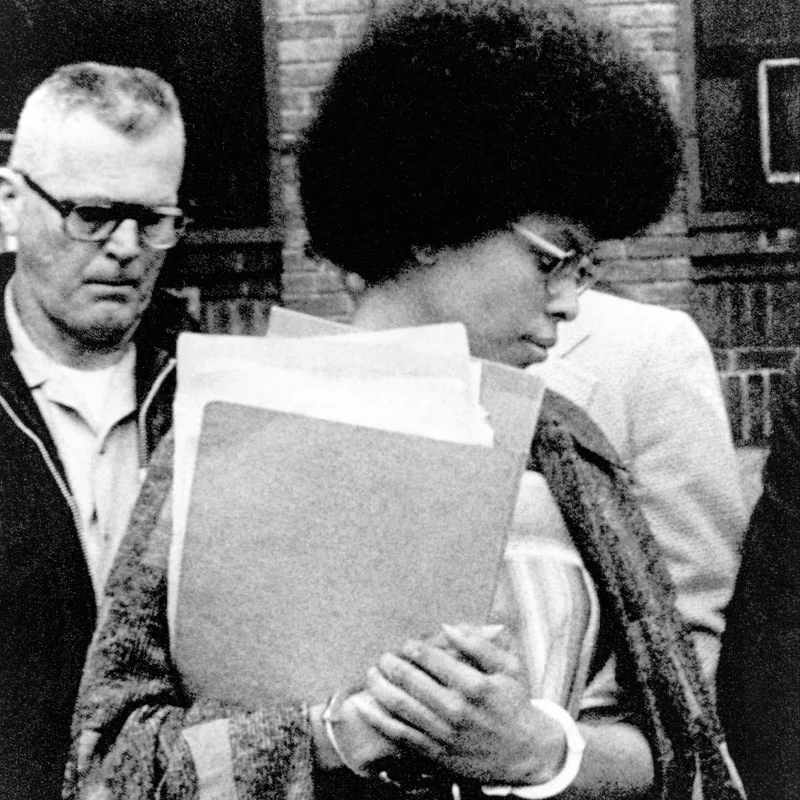
Assata Shakur, Racial Justice Activist, Dies at Age 78
Assata Shakur, a prominent Black liberation activist and longtime political refugee, died on Sept. 25 in Havana, Cuba, at age 78. The U.S. government categorized Shakur as a dangerous terrorist, but to many supporters, she was a symbol of resistance and a source of inspiration.
Early Activism

After graduation, she adopted the name Assata Olugbala Shakur and briefly joined the Black Panther Party, an activist group focused on the protection and care of the Black community.
Later, she joined the more militant Black Liberation Army (BLA). The BLA believed that “law is never impartial, never divorced from the economic relationships that brought it about” and advocated for “total liberation from those forces that maintain our oppressive condition.”
Shakur spent the early 1970s fighting a range of criminal charges against her, including robbery, kidnapping, and murder. In every case, she was either acquitted or the charges were ultimately dismissed.
New Jersey Turnpike Shootout
In 1973, however, a car in which she was riding with fellow Black activists Zayd Malik Shakur and Sundiata Acoli was stopped by New Jersey law enforcement. A shootout occurred that resulted in the deaths of Zayd Malik Shakur and state trooper Werner Foerster. Assata Shakur was shot in the arm, and Acoli was wounded.
Supporters cited evidence suggesting her innocence. Shakur was found guilty of the state trooper’s murder by an all-white jury in 1977 and was sentenced to life in prison.
Targeted by COINTELPRO
Shakur believed she had been targeted by the Counter Intelligence Program (COINTELPRO), a covert FBI program created by J. Edgar Hoover to stop communism and squelch other forms of political dissent in America.
“Under the COINTELPRO program, many political activists were harassed, imprisoned, murdered or otherwise neutralized,” Shakur wrote in a 1998 open letter published on her website.
“The FBI, with the help of local police agencies, systematically fed false accusations and fake news articles to the press, accusing me and other activists of crimes we did not commit.
Although in my case the charges were eventually dropped or I was eventually acquitted, the national and local police agencies created a situation where, based on their false accusations against me, any police officer could shoot me on sight.
It was not until the Freedom of Information Act (FOIA) was passed in the mid-’70s that we began to see the scope of the United States government’s persecution of political activists.”
Other Black activists targeted by COINTELPRO include Martin Luther King, Malcolm X, Elijah Muhammad, and Black Panther Party members Bobby Hutton, Fred Hampton, and Mark Clark.
Political Asylum in Cuba
With the help of fellow activists, Shakur escaped from prison in 1979 and fled the United States. She was the first woman to be included on the FBI’s Most Wanted list, and the FBI offered a $2 million reward for her capture. She was granted political asylum in Cuba by Fidel Castro in 1984 and lived the rest of her life there.
While in Cuba, she continued her activist work primarily through books, articles, and interviews. A detailed archive of her writings remains available on her website www.assatashakur.org.
“At this point, I think that it is important to make one thing very clear,” Shakur wrote in 1998. “I have advocated and I still advocate revolutionary changes in the structure and in the principles that govern the United States.
I advocate self-determination for my people and for all oppressed people inside the United States. I advocate an end to capitalist exploitation, the abolition of racist policies, the eradication of sexism, and the elimination of political repression. If that is a crime, then I am totally guilty.”
Responses to Her Death
In a Sept. 28 post on X, former FBI director Kash Patel reiterated the government’s belief in her guilt.
“The FBI never stopped calling her what she was: a terrorist,” Patel wrote. “Mourning her is spitting on the badge and the blood of every cop who gave their life in service.”
In a Sept. 26 post on X, the Chicago Teachers Union memorialized her differently, calling her “a revolutionary fighter, a fierce writer, a revered elder of Black liberation, and a leader of freedom whose spirit continues to live in our struggle.” This post was criticized by Chicago alderpersons but supported by Chicago Mayor Brandon Johnson.
Presidential professor of Anthropology and Urban Educator Dr. Marc Lamont Hill remembered Shakur as “a legend and a mentor and a resource to so many of us.”
“Although she remained hidden in Cuba, especially in the later years, she just stands tall and strong, and I’m grateful that she was able to live free and die free,” Hill said on a recent episode of “The Joe Budden Podcast.”
“So we always say hands off Assata, always free all political prisoners, always love to Assata. So we say rest in peace as she returns to the ancestors.”
Angela Hay is a professional writing & journalism student at Capital University in Columbus, Ohio. She has written and edited for Capital Stories, Capital Magazine, and the university’s student newspaper, the Chimes.